


Attackers are exploiting CVE-2026-131914, a critical remote code execution flaw in the abandoned Idunno.AntiCsrf library for ASP.NET, and there is no patch coming because the project has had no maintainer since 2008.
CVE-2026-131914 is an insecure deserialization bug (CWE-502) in Idunno.AntiCsrf.dll, a third-party module that older ASP.NET WebForms sites load to block cross-site request forgery. Mandiant, the CVE numbering authority for the bug, rates it 9.3 (Critical) under CVSS 4.0. One unauthenticated POST request is enough to run code inside the IIS worker process, w3wp.exe.
Google’s Mandiant published advisory MNDT-2026-0048 on Wednesday, November 18, and said it had already seen active exploitation.
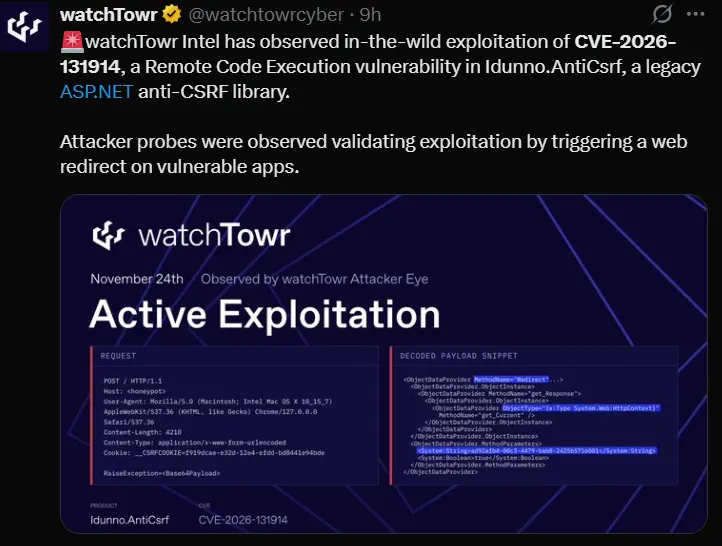
On Tuesday, November 24, watchTowr reported that its honeypots were catching in-the-wild exploitation attempts, and a working proof-of-concept exploit is now public on GitHub.
As of November 24, no fixed version of Idunno.AntiCsrf exists, and the only remediation is to remove the library.
How the Idunno.AntiCsrf Flaw Works
Idunno.AntiCsrf uses the double-submit pattern. The server sets a token in a cookie (__CSRFCOOKIE) and in a hidden form field, then checks that the two match. The module was last released as version 0.9.1 Beta (DLL version 0.9.1.0) in 2008 on Microsoft’s now-retired CodePlex platform, and many teams copied it straight into their bin/ folders rather than installing it through a package manager.
According to Mandiant, the AntiCsrfModule HTTP module deserializes the form-field token with an ObjectStateFormatter that has no key, so no MAC (message authentication code) or signature is checked. That happens in the PreRequestHandlerExecute event, which runs before the page’s own Page_Load code. The deserializer fires whenever the CSRF cookie contains any value and the form field is present, so the attacker never needs a valid token or session.
The targeted page does not need a <form runat="server"> either. Only pages that implement ISuppressCsrfCheck or carry the [SuppressCsrfCheck] attribute skip the check, so on most sites using the library, almost any .aspx endpoint is a way in.
This is why the Idunno.AntiCsrf bug is easier to exploit than classic ASP.NET ViewState attacks. ViewState deserialization normally requires a stolen or leaked machineKey to forge a valid MAC. The AntiCsrf token has no MAC at all, so public ysoserial.net gadget chains work without any key, and rotating the machineKey does not close the hole.
Mandiant also documents a setter bug in the library. If the <csrfSettings> section is missing from Web.config, the form field’s name is overwritten with the string RaiseException. Sites that dropped in the DLL without that configuration block therefore accept the malicious payload under a predictable field name.
Mandiant credits the discovery to LDB; Genwei Jiang and Dhanesh Kizhakkinan of Google Cloud’s FLARE team; and Brian Bahtiarian and Lucas Kossack of Mandiant Incident Response. FLARE finished its root-cause analysis on November 4 during an incident response investigation, which is how the flaw came to light in an attack rather than through bug hunting.
Is CVE-2026-131914 Being Exploited?
Yes. Mandiant’s advisory states that it has observed active exploitation, and its CVSS vector carries the exploit-maturity value E:A (“Attacked”). Mandiant has not named victims, attributed the activity to a threat actor, or described what the attackers did after gaining access.
watchTowr said its Attacker Eye sensors caught probes on November 24 that test for the bug by triggering a web redirect. The request watchTowr published is a POST that sets a __CSRFCOOKIE cookie and sends a Base64 payload in a form field named RaiseException, the same fallback name Mandiant describes for installs with no csrfSettings section. The probes are aimed at default-configured deployments.
watchTowr’s decoded payload is a .NET ObjectDataProvider gadget. It fetches HttpContext.Current, gets the response object and calls Redirect with a unique string. If the server answers with that redirect, the attacker knows the deserialized code ran, without dropping files or spawning a process. A redirect on its own is not proof of compromise, but it confirms the site is exploitable. watchTowr has not said where the redirects point or whether follow-on payloads were sent.
The public proof-of-concept on GitHub is a single Python 3 script with no dependencies outside the standard library. It builds its own payload using a gadget chain attributed to ysoserial.net and can execute a specified command on the target. It can also trigger an out-of-band DNS lookup carrying the server’s hostname, and it has a dry-run mode. The author says it targets .NET Framework 4.x WebForms sites reachable without a login, was tested only in a lab, and warns that targets return HTTP 500 even when the command succeeds.
CVE-2026-131914 was not in CISA’s Known Exploited Vulnerabilities catalog as of catalog version 2026.11.20, according to the third-party trackers cve.now and Zero Hunt. Zero Hunt also reports that the CVE record carries a CISA SSVC entry of “exploitation: none”, which contradicts Mandiant’s advisory. Cyber Kendra could not independently confirm either entry.
Which Idunno.AntiCsrf Versions Are Affected
Mandiant lists Idunno.AntiCsrf version 0.9.1.0 (“0.9.1 Beta”) as affected, along with internally recompiled builds that keep the vulnerable code. The advisory gives SHA-256 hashes for three known builds, including da1efcfed182597ee946a9ef2895dfdfeab2bdff16855aeef01656d8158ead06 for the official 2008 release. Custom builds will not match those hashes.
The flaw sits in the optional third-party module, not in ASP.NET WebForms or IIS. Microsoft has no patch to ship, and Mandiant’s advisory lists no fixed version and tells users to stop using the library.
What ASP.NET Admins Should Do Now
First, find the library. Search every application’s Web.config and bin/ directory for “AntiCsrf” by name rather than relying on hashes, because recompiled copies differ. On a Windows server, Get-ChildItem -Path C:\inetpub -Recurse -Include Idunno.AntiCsrf.dll,web.config | Select-String -Pattern "AntiCsrf" -List lists matching files under the default IIS root; widen the path for sites hosted elsewhere.
Mandiant’s remediation is to remove the module registrations from <httpModules> and <modules>, delete the csrfSettings config section and element, and delete Idunno.AntiCsrf.dll from bin/. Then replace it with a supported anti-forgery mechanism: System.Web.Helpers.AntiForgery, ViewStateUserKey with MAC-protected ViewState, or IAntiforgery in ASP.NET Core. Recycle the application pool afterwards so the old module is unloaded.
To hunt for compromise, Mandiant advises reviewing IIS logs for unusual POST requests to .aspx pages that returned HTTP 302 or 500. The 302 matches watchTowr’s redirect probes, and the 500 matches the public exploit’s behaviour. Admins should also look for w3wp.exe launching cmd.exe or powershell.exe, and check webroots for unfamiliar files such as web shells.
If exploitation is suspected, Mandiant says to rotate every secret in Web.config and applicationHost.config, including the machineKey, encryption keys and database credentials. Removing the DLL closes the entry point, but it does not undo anything an attacker already ran.
Mandiant lists no workaround that leaves the library in place.
Community Discussion
Join the conversation. Ask questions, share solutions, and help others.
Be the first to start the discussion!