



Broadcom’s acquisition of VMware hit the hypervisor market like a freight train. Licensing fees surged, renewal quotes left IT teams reeling, and organisations that had run vSphere for years suddenly found themselves actively hunting for something better.
Choosing among the leading hypervisor platforms for virtual machine management now demands more than a feature checklist; it means matching architecture, support model, and total cost to what an IT team can genuinely sustain over the long term.
This list covers five platforms that recur in enterprise evaluations. The entries are based on documented capabilities, independent ratings, and verified company data.
What You Should Know Before Choosing a Hypervisor
Not every hypervisor fits every environment. Type-1 (bare-metal) hypervisors install directly on physical servers and are the standard choice for production workloads. They eliminate the host OS layer and give VMs direct hardware access. Type-2 hypervisors run on top of an OS and belong in dev/test environments, not data centres.
Beyond architecture, the questions worth answering before committing to a platform:
- Hardware compatibility: Does the hypervisor support the servers already in the rack, or will migration require purchasing new hardware?
- Migration tooling, how much manual work does a workload move actually take, and does the vendor ship automation for it?
- Bundled vs. add-on pricing, some platforms charge separately for networking, storage, and security layers that others include by default.
- Ecosystem depth, third-party backup tools, monitoring integrations, and a trained talent pool all shrink or grow depending on which platform wins.
- Support model, a vendor-backed support contract versus a community forum, matters differently for a 500-VM production cluster than for a lab.
1. Sangfor aSV Hypervisor
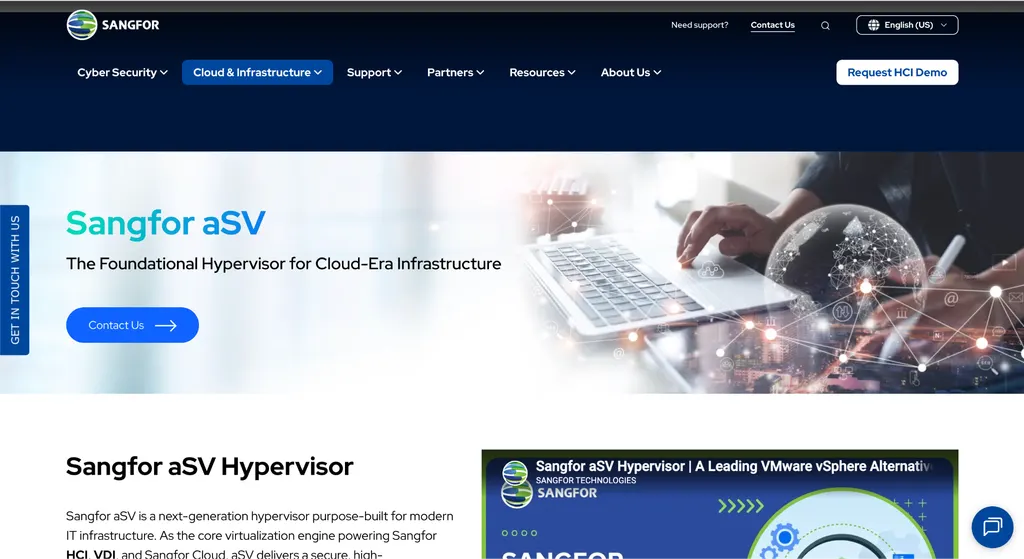
Sangfor aSV Hypervisor is a type-1, KVM-based bare-metal hypervisor that bundles compute virtualisation, software-defined networking, storage, and built-in security into a single license, making it a direct structural alternative to VMware vSphere for enterprises reassessing their virtualisation costs.
- Main products: aSV ships 230-plus commands equivalent to VMware’s PowerCLI, so existing automation scripts and admin workflows carry over. Sangfor reports more than 12,000 completed VMware migrations across its customer base. aNET, aSAN, and aSEC, networking, storage, and security, come bundled inside the same license rather than as separate purchases, the way VMware prices NSX and vSAN. Proactive HA 2.0 predicts node failures before they occur; live migration delivers under 3 seconds of measured performance impact, keeping host maintenance invisible to end users. Runs on standard x86 servers from Dell, HPE, Lenovo, and others. Pricing is quote-based with perpetual or subscription terms.
- Analyst recognition: Sangfor Cloud Platform holds a 4.7-out-of-5 rating across 94 reviews on G2 and carries a Leader badge in the G2 Server Virtualisation and Hyperconverged Infrastructure grids for Summer 2026. Gartner named Sangfor a Representative Vendor in its 2025 Market Guide for Server Virtualisation Platforms.
- Worth knowing: Sangfor positions aSV as a direct VMware migration path for organisations facing unexpected renewal costs.
2. VMware
VMware, now owned by Broadcom, remains the most widely deployed enterprise hypervisor platform, built around vSphere and Cloud Foundation, with a documented customer base spanning nearly every major industry.
- Main products: VMware Cloud Foundation and VMware vSphere Foundation anchor the portfolio, with add-on services covering disaster recovery, private AI, container operations, load balancing, and edge orchestration. VMware reported $13.4 billion in revenue as of 2023 and employs approximately 38,300 people. The company has 287 published customer case studies on file, including Grinnell Mutual, which saved $1 million in infrastructure costs using VMware Cloud Foundation, and GCI, an Alaska-based communications provider that deployed Cloud Foundation alongside Tanzu Data Services. VMware Cloud Foundation received a 2025 Tech Award for the most innovative cloud infrastructure solution.
- Analyst recognition: G2 rates vSphere at 8.7 out of 10 across 195 reviews in the server virtualisation category.
- Worth knowing: The Broadcom acquisition restructured VMware’s licensing. Many customers report sharp cost increases at renewal, which is why competing platforms have seen increased evaluation traffic.
3. Nutanix
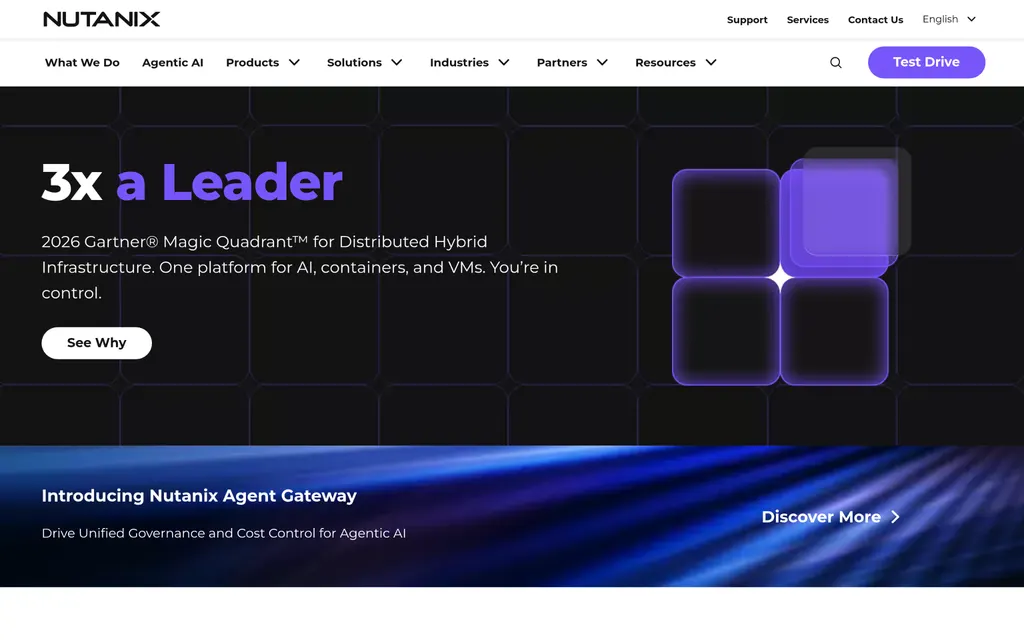
Nutanix offers a cloud platform built around its AHV hypervisor and AOS storage layer, positioned for organisations running hybrid and multicloud workloads with a focus on management simplicity across distributed infrastructure.
- Main products: Nutanix Cloud Platform combines AHV virtualisation, AOS storage, Nutanix Flow networking, Nutanix Kubernetes Platform, a unified storage layer (files, objects, volumes, block), Nutanix Database Service, and an enterprise AI layer, all managed through a single console. Founded in 2009, headquartered in San Jose, California, traded on NASDAQ (NTNX), with approximately 7,800 employees.
- Analyst recognition: Gartner named Nutanix a Leader in both the 2026 Magic Quadrant for Server Virtualisation Platforms (highest in execution) and the 2026 Magic Quadrant for Distributed Hybrid Infrastructure, and a Challenger in the 2026 Magic Quadrant for Container Management.
- Worth knowing: Nutanix’s certified hardware list is narrower than some competitors, which can limit options for organisations with existing third-party server investments. Per Sangfor’s own published comparison data (2025 Q4), Nutanix had a 4.7 overall rating on Gartner Peer Insights compared to Sangfor’s 4.9, though those figures come from a vendor page and should be verified independently.
4. Proxmox
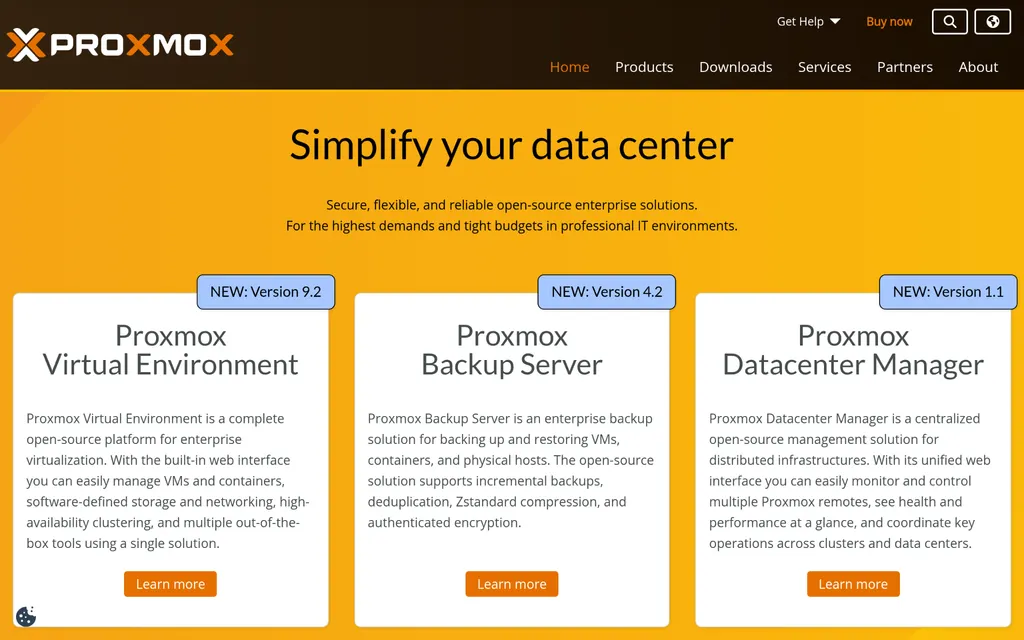
Proxmox Virtual Environment is an open-source, KVM-based platform that has become the no-cost alternative to VMware, managing more than 1.5 million hosts globally as of 2026.
- Main products: The full feature set, including KVM virtualisation, LXC container support, software-defined storage, and a web-based management interface, is available without a commercial subscription. Paid support subscriptions are sold separately for organisations that want them. Proxmox VE has partnerships with 1,000-plus resellers across 142 countries and counts the European Space Agency, YouTube, and Northrop Grumman among its deployments. Hardware and software partnerships include NVIDIA and Veeam. Proxmox estimates that roughly 95% of VMware setups can migrate to Proxmox VE without significant friction, which is a claim that resonates with organisations facing unexpected VMware renewal costs.
- Analyst recognition: Proxmox does not have published Gartner or G2 quadrant recognition comparable to other platforms on this list.
- Worth knowing: Proxmox requires more manual assembly than appliance-style platforms. Storage, networking, HA, and DR involve separate configuration steps, often through the CLI. Paid support is delivered remotely via ticketing rather than on-site. The company is headquartered in Vienna, Austria, and as of August 2026 has 68 employees, which is a modest team relative to enterprise-scale deployments.
5. Red Hat
Red Hat delivers enterprise Linux and container-focused infrastructure, and its virtualisation story now centres on OpenShift Virtualisation: running VMs alongside containers on the same Kubernetes-based platform.
- Main products: Red Hat Enterprise Linux (RHEL), OpenShift Container Platform, Ansible Automation Platform, and Red Hat AI form the portfolio backbone. Virtualisation is delivered through OpenShift Virtualisation rather than a standalone hypervisor product. Red Hat supports more than 90% of Fortune 500 companies and operates across automotive, financial services, healthcare, public sector, and telecommunications verticals. The company has 19,000 employees and is a subsidiary of IBM (acquired in 2019).
- Analyst recognition: Red Hat was named a Leader in the 2026 Gartner Magic Quadrant for Cloud-Native Application Platforms for a third consecutive year, and has held a Leaders quadrant position in a separate Gartner Magic Quadrant for four consecutive years.
- Worth knowing: Red Hat’s virtualisation approach is container-first. Organisations looking for a direct, traditional hypervisor replacement will find OpenShift Virtualisation more opinionated than a platform like vSphere or AHV. It fits teams already standardising on Kubernetes; it’s a harder fit for shops that want a pure VM management layer without the overhead of container orchestration.
Bottom Line
The best platform starts with where you already are. Organisations coming off VMware who need minimal operational disruption should look hard at platforms that ship VMware-compatible tooling and built-in migration automation. Teams with hardware flexibility and a real appetite for open-source will find Proxmox remarkably cost-effective – provided they’ve got the in-house skills to configure and maintain it properly.
Nutanix and Red Hat serve very different profiles: Nutanix suits hybrid cloud management with strong analyst backing, while Red Hat fits shops where Kubernetes is already the operating model. Any honest evaluation of top hypervisor platforms for virtual machine management should test against actual workloads and hardware – not just vendor feature matrices, and get real pricing quotes before the shortlist closes.


Community Discussion
Join the conversation. Ask questions, share solutions, and help others.
Be the first to start the discussion!