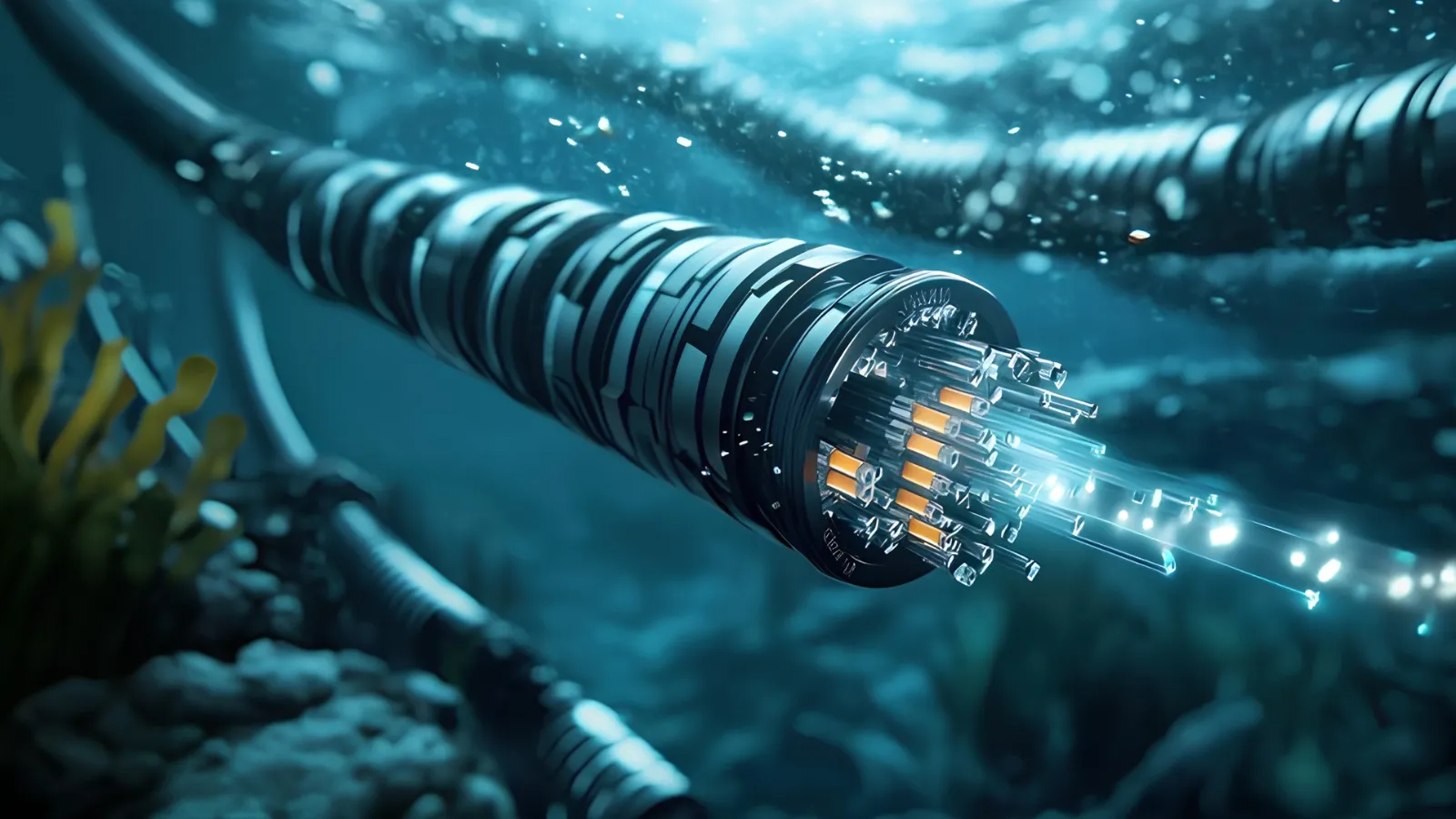
Meta has announced Petal, a subsea cable designed to carry 1 petabit per second (1 Pbps, or 1,000 terabits per second) over roughly 7,000 km (4,300 miles) between the United States and France. Meta says Petal will be the first cable to deliver petabit capacity across an ocean and the first subsea system to use multi-core optical fiber at scale. Petal is expected to enter service in 2029.
Petal will double the roughly 0.5 Pbps carried by Anjana, Meta’s current highest-capacity transatlantic cable, by using 2-core fiber. Each glass strand in Petal carries two light paths instead of one, so the cable’s 24 fiber pairs perform like 48. NEC is building the system, Sumitomo Electric Industries is supplying the fiber, and Orange will land Petal on France’s Atlantic coast.
Meta announced Petal, calling it “the single largest generational increase in capacity” for any transoceanic subsea cable. The 1 Pbps figure is a design target. As of September 22, 2026, Petal has not been laid, and its capacity has not been demonstrated on an installed system.
What Does 1 Pbps Actually Mean?
One petabit per second equals 1,000 terabits per second, or about 125 terabytes of raw data per second before accounting for networking overhead. Meta says Petal’s capacity roughly matches what 75% of the world’s population would need to stream music simultaneously. Meta’s calculation assumes a 160 kbps audio stream, which works out to about 6.25 billion simultaneous streams.
How Does Petal Compare With Meta’s Other Transatlantic Cables?
Petal will have about 5.5 times the capacity of Marea, Meta’s first transatlantic cable, and twice the capacity of Anjana, according to Meta. Every earlier Meta cable across the Atlantic raised capacity by adding fiber pairs. Petal is the first to add cores inside the fiber instead.
Also Read
| Cable | Milestone | Route | Fiber pairs | Capacity |
|---|---|---|---|---|
| Marea | In service 2018 | Virginia Beach, US – Bilbao, Spain | 8 | 192 Tbps |
| Amitié | In service July 2023 | Lynn, US – Le Porge, France and Bude, UK | 16 | 400 Tbps |
| Anjana | Landed in Spain in October 2024 | Myrtle Beach, US – Santander, Spain | 24 | ~500 Tbps |
| Petal | Service expected 2029 | US – France (Atlantic coast) | 24 two-core (equal to 48) | 1,000 Tbps |
Marea figure from Meta’s September 2026 comparison chart; Amitié from Orange; Anjana from Meta’s October 2024 landing announcement; Petal from Meta.
Petal’s gain comes from more light paths rather than faster ones. Meta rated each of Anjana’s 24 fiber pairs at a design capacity of roughly 20 Tbps in its 2024 Anjana announcement. Spread across Petal’s 48 equivalent fiber pairs, 1 Pbps works out to about 20.8 Tbps per pair.
Why Did Meta Choose 2-Core Fiber for Petal?
Meta says it had three ways to double Anjana’s capacity. The first was adding fibers until the cable held 48 pairs. The second was lighting the L-band, a wavelength range next to the standard C-band, across 24 pairs, as Meta did on its transpacific PLCN cable. The third was 2-core fiber, which Meta picked for Petal.
Meta says a single 1 Pbps cable uses significantly fewer materials and resources, and produces a smaller carbon footprint, than two separate 0.5 Pbps cables delivering the same capacity.
How Does Petal’s 2-Core Fiber Work?
Conventional subsea fiber has one core, the light-guiding center of a glass strand, and each direction of traffic runs on a separate fiber within a pair. Petal’s 2-core fiber puts both directions inside one strand, with the signals in the two cores travelling in opposite directions.
Sumitomo Electric had to solve two problems to make 2-core fiber work over 7,000 km. The first was attenuation, the gradual loss of signal strength along the fiber, which Sumitomo kept low by making the fiber from ultra-pure synthetic silica. The second was crosstalk, where light leaks from one core into the other. Sumitomo contained crosstalk through refractive-index design around each core and by running the two cores’ signals in opposite directions, leaving crosstalk barely measurable, according to Meta.

Petal’s fiber keeps the standard 125-micrometer outer diameter, about the width of a human hair. Sumitomo draws the fiber from a glass preform 2 to 3 meters long and 20 cm wide, stretching it into thousands of kilometers of strand. Sumitomo sells the product as 2C Z-PLUS ULL Fiber, where ULL stands for ultra-low loss.
How Does Petal Double Capacity Without Doubling Power?
Petal will remain within the 18 kV rating of the existing subsea power-feeding equipment, according to Meta. Going above that voltage would force the industry to requalify its subsea equipment, a step Petal’s design avoids.
A 7,000 km subsea cable typically needs about 100 repeaters, the sealed underwater amplifiers that boost the light signal along the route. Each Petal repeater is a single housing with 96 amplifiers, matching the 96 fiber cores in the cable. Inside each repeater, a Fan-In/Fan-Out (FIFO) interface splits every 2-core fiber into two single-core fibers, standard single-core amplifiers boost the signals, and the FIFO merges them back into 2-core fiber.
Petal’s amplifiers also share pump lasers, the light sources that power optical amplification, through what Meta calls an SDM pump-sharing architecture. SDM, or spatial division multiplexing, means adding capacity through more parallel light paths rather than squeezing more data into each one.
Who Is Building Petal?
NEC is Petal’s turnkey supplier. NEC engineered and qualified the full system, including the 2-core fiber cable, repeaters, FIFO components and power feeding, and will manufacture and install Petal. Sumitomo Electric Industries supplies the 2-core fiber to NEC.
Orange is working with Meta to land Petal on France’s Atlantic coast and connect it to the European terrestrial network. Orange executive Jean-Louis Le Roux noted in Meta’s engineering post that the petabit link arrives “25 years after the terabit milestone.” Orange is already the French landing party for Amitié, the Meta-backed transatlantic cable that lands at Le Porge near Bordeaux.
What Meta Has Not Disclosed About Petal
As of September 22, 2026, Meta has not named Petal’s US landing site or the exact French landing site. Meta has also not disclosed Petal’s cost, its full route, or whether Petal will be wholly owned by Meta, as Anjana is. Meta has not published an installation schedule beyond the 2029 service date.
What Petal Means for Internet Users
Petal will not directly speed up home or mobile connections. Subsea cables carry about 99% of intercontinental data traffic, and Petal adds backbone capacity and another physical route between North America and Europe. Meta says Petal brings more capacity and resiliency to Europe as demand for connectivity grows.
Meta positions Petal as the project that takes multi-core fiber from experimental use to mainstream subsea construction, and it has invited other cable builders to invest in the technology. Meta says it has invested in more than 20 subsea cable projects, including Project Waterworth.

Community Discussion
Join the conversation. Ask questions, share solutions, and help others.
Be the first to start the discussion!