


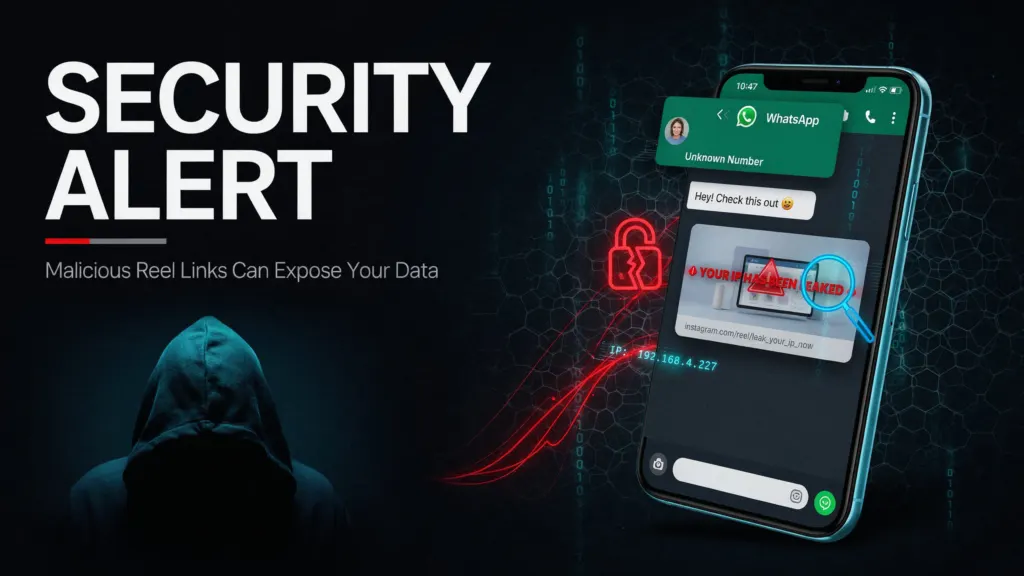
A security researcher has reverse-engineered CVE-2026-23866, a patched WhatsApp flaw in how it handles Instagram Reels, and reproduced a one-click version of the attack, concluding that the more serious zero-click path Meta described remains unconfirmed.
Meta disclosed the vulnerability on May 1, 2026, rating it medium severity with a CVSS score of 4.3. According to the advisory, incomplete validation of AI-rich response messages for Instagram Reels “could have allowed a user to trigger processing of media content from an arbitrary URL on another user’s device, including triggering OS-controlled custom URL scheme handlers.”
The bug affected WhatsApp for iOS from version 2.25.8.0 through 2.26.15.72 and for Android from 2.25.8.0 through 2.26.7.10, and was reported through Meta’s Bug Bounty Program.
The flaw lies in how WhatsApp parses the message type that renders an Instagram Reel preview inside a chat. That message contains a block of attacker-supplied fields — a title, a profile icon, a thumbnail, and a video URL — and the app extracts those URLs from the message without first verifying that they point to a trusted destination, such as Instagram’s own servers. A sender who crafts the message can therefore substitute a server they control.
In a write-up published October 5, the researcher, who goes by Numb3rs, traced that extracted URL through the iOS binary to the point where WhatsApp hands it to the system to open. On current patched builds, sending such a message and tapping the Reel preview redirected the device straight to the attacker’s URL in Safari — enough to leak the victim’s IP address, request headers and user agent to an arbitrary host. That is the one-click chain, and it still fires on a tap.
What the researcher could not reproduce is the zero-click behaviour implied by the CVE: automatic processing of media from the attacker’s URL with no interaction at all. “I can confirm the 1-click path but not the 0-click one,” Numb3rs wrote.
The investigation ran into two walls. Meta compiles the relevant WhatsApp code inline with the -O1 optimisation flag, which collapses the function boundaries that normally allow diffing a vulnerable build against a patched one. And dynamic testing against a genuinely vulnerable version was impossible because WhatsApp’s backend refuses to register the old client builds that would still contain the bug. The researcher suggested that hardcoding a newer version string, resetting the device clock past the app’s expiry date, or injecting a custom dynamic library to force the vulnerable code path might work, but listed all three as unfinished future work.
Meta patched CVE-2026-23866 in the versions listed above and has said it found no evidence of exploitation in the wild. The company disclosed the Reels flaw alongside CVE-2026-23863, an unrelated attachment-spoofing bug in WhatsApp for Windows involving filenames with embedded NUL bytes. Users on affected builds should update to the current release, which validates the Reel URLs before loading them.
Community Discussion
Join the conversation. Ask questions, share solutions, and help others.
Be the first to start the discussion!