

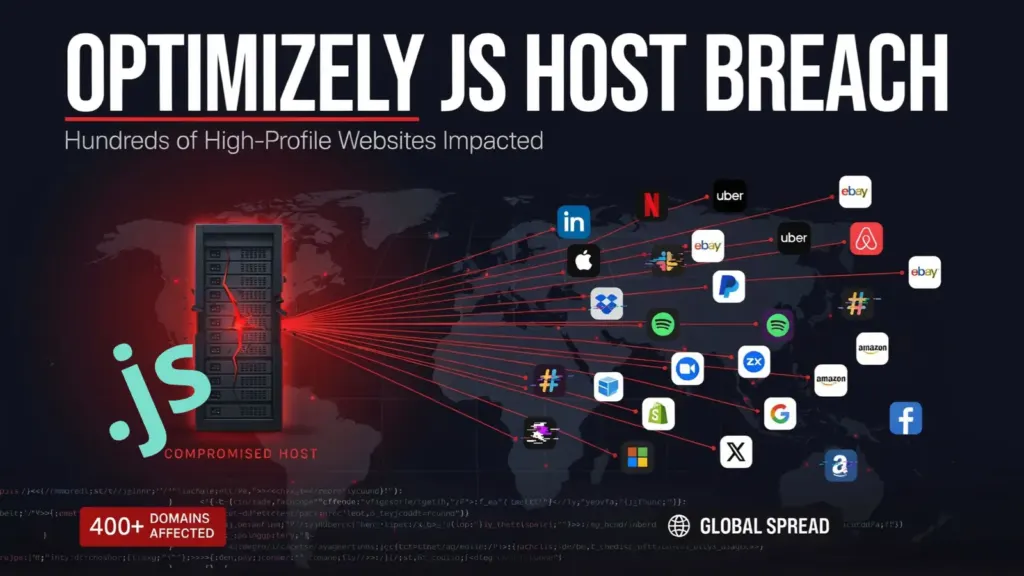
Malicious JavaScript served through Optimizely Web, a widely used A/B testing platform, ran on the websites of 178 organizations on Monday, November 16, swapping cryptocurrency wallet addresses, skimming payment cards, and pushing iOS exploit kits at visitors to Zoom, the BBC, CNN, Salesforce, GitLab, and HSBC.
Scott Helme, founder of the security monitoring service Report URI, disclosed the campaign after checking 1,611 Optimizely scripts and finding 188 infected, belonging to 178 organizations. An earlier count from the same sweep, 186 infected scripts, is the figure that first circulated on social media. Independent researcher Amirul Cyber named the campaign OPTIMJACK.
The poisoned files were delivered from Optimizely’s own domain, cdn.optimizely.com, with a valid Optimizely certificate, so browsers and most security allowlists treated them as legitimate. “Trusted JavaScript doesn’t always remain trustworthy,” Helme said in the report.
By 21:52 UTC on November 16, Report URI found the malicious code in only one of the 188 scripts, belonging to UK broadband provider TalkTalk. As of November 17, Optimizely has not published a statement that Cyber Kendra could find, and nobody has explained how the attacker got in.
How the Optimizely Attack Worked
Optimizely Web customers add a single script, called a snippet, to their pages. The snippet is hosted by Optimizely and carries the platform’s code, the customer’s experiments, and an optional field called Project JavaScript, which holds custom code that runs on every page.
The attacker wrote a short loader into the Project JavaScript field of many unrelated customers’ projects, according to Report URI. The loader added a script tag pointing to 1688360[.]cc/track.js, the attacker’s server, and left the rest of each snippet untouched.
The Report URI indicates the incident was not CDN cache poisoning because the content delivery network served exactly what Optimizely’s platform provided. That points to write access inside the platform itself, and Helme lists a compromised Optimizely system or a credential with cross-customer access as possibilities without confirming either. The snippets for www.optimizely.com and login.optimizely.com also carried the code.
The first Optimizely injection Report URI found was in the BBC’s snippet at 04:21 UTC on November 16, two hours after the last clean capture. The attacker registered 1688360[.]cc at 05:23 UTC, built the first version of track.js at 08:10 UTC, and added a card skimmer at 13:43 UTC. Report URI recorded 26 payload rebuilds during the day.
Some snippets also carried a full copy of the malware inside the trusted file. Hudson Rock recovered BBC and HSBC UAE scripts with an identical 24,392-byte Base64-encoded payload that runs if the remote download fails or takes longer than 2.5 seconds, so blocking the attacker’s domain did not stop it.
What the OPTIMJACK Malware Did to Visitors
Every visitor to an infected page received the same track.js script with all of its components active, Report URI says. The main component is a crypto clipper, malware that replaces a wallet address with the attacker’s at the moment the victim uses it.
The clipper recognizes Bitcoin, Ethereum, and other EVM chains; TRON, Solana, TON, Litecoin, Bitcoin Cash, and Dogecoin addresses; checks that each is valid; and swaps them into page text, forms, links, the clipboard, outgoing network requests, and the iOS share sheet. StepSecurity, which read the code independently, says the swap happens only near payment words such as “wallet”, “deposit” or “send”.
The card skimmer watches form submissions for a card number, expiry date, and CVV, and sends them to the attacker’s server. Payment fields hosted by a processor inside a separate frame, such as those from Stripe or Adyen, were out of its reach; card fields built into a site’s own page were not.
When the script swapped an address, it also sent the attacker the page URL, a screenshot of the page, and any cookies that JavaScript can read. Cookies flagged HttpOnly were not exposed.
On iPhones and iPads, the script loaded a second stage from attacker-registered .icu domains and ran an exploit chain in a hidden frame, chosen based on the iOS version. Report URI identifies the chains as Coruna and DarkSword, two iOS exploit kits that Google’s Threat Intelligence Group documented in March 2026.
| iOS Version on the Device | What the Script Delivered (per Report URI) | Status as of November 17 |
|---|---|---|
| iOS 13 to 17 | Coruna exploit kit | Exposed; update required |
| iOS 18.0 to 18.7.2 | DarkSword exploit kit | Exposed; update required |
| iOS 18.7.3 or later | DarkSword attempted | Patched |
| iOS 26.0 to 26.2 | Separate chain that only fingerprints the device | Update to 26.3 or later |
| iOS 26.3 or later | Fingerprinting only | Patched |
Nobody has shown that an iPhone was actually compromised through OPTIMJACK. Hudson Rock retrieved the exploit delivery pages using iOS 18.6 and 17.5 browser identifiers but ran the tests in headless Chrome, so the results prove delivery, not successful exploitation. StepSecurity did not retrieve or analyze the iOS files.
Which Websites Were Affected
Report URI’s list of affected organizations includes Zoom, the BBC, CNN, Salesforce, GitLab, IKEA, HSBC in several regions, Equifax, Air France-KLM, Ledger, Peacock, Fox News, ASOS, Levi’s, Vodafone Australia, Virgin Media, Starbucks Canada, Heineken, Change.org, UNICEF USA and PokerStars. The full per-domain list is in the Report URI post.
Banking and finance was the largest group with 32 organizations, followed by technology and software with 23, retail and fashion with 20, streaming and entertainment with 12, and news and media with 10. Helme says the true total is probably higher, because the 1,611 scripts Report URI checked are not every Optimizely customer.
StepSecurity found the payload itself stored in urlscan.io captures for 17 domains, including CNN, the BBC, Fox News, Zoom, Salesforce, GitLab, Hootsuite, Smartsheet, Air France, KLM and American Eagle. Appearing on a list means the site’s Optimizely script was infected; it does not mean the site’s own servers were breached.
Optimizely was not the only route. Report URI and Hudson Rock both traced an earlier wave, from November 13 to 16, in which the same actor’s injector script from webshell[.]lol was served through Kissmetrics, StorifyMe, and Minute Media’s minute-ly scripts. Hudson Rock tied those to sites including securitybank.com, faz.net, smh.com.au and foxsports.com.
Is the Optimizely Attack Still Active?
The Optimizely injection was largely removed on the evening of November 16. Report URI recorded a mass clean-up between about 20:40 and 21:10 UTC, with the number of infected scripts falling from 169 at 20:56 UTC to 1 at 21:52 UTC. Reports published on November 17 that describe the attack as ongoing rely on the earlier count.
A clean script today does not show that it was clean on November 16, StepSecurity notes. The exposure window for a given site runs from its first infection, as early as 04:21 UTC, to the clean-up roughly 17 hours later.
The visible haul is small. Report URI counted about $7,040 in the attacker’s wallets by 19:25 UTC on November 16, most of it Bitcoin, and StepSecurity’s own count came to about $6,600. Neither figure covers stolen cards, cookies or iOS access, which leave no trace on a blockchain.
Helme says he sent the full details through several channels and received no response at the time of publication. Optimizely confirmed in February 2026 that attackers had accessed some of its internal systems via a voice-phishing attack; no researcher has linked that incident to OPTIMJACK. The operator’s identity, the method of access, and the number of affected visitors are all unknown.
What Visitors and Site Owners Should Do Now
Anyone who opened an affected site on an iPhone or iPad on November 16 should update to iOS 18.7.3 or later, or iOS 26.3 or later, which Report URI says are patched against both kits. The installed version is shown under Settings > General > About.
Anyone who copied or pasted a crypto address on an affected site that day should compare it, character by character, with the intended address before sending funds and, where possible, confirm it on a hardware wallet screen. A completed transfer to a swapped address cannot be reversed.
Anyone who entered card details into an affected site’s payment form on November 16 should monitor statements for unfamiliar charges, and StepSecurity advises treating that card as compromised and replacing it. Visitors who only read pages on a desktop browser and did not handle crypto addresses or enter a card had nothing for the clipper or skimmer to take.
Optimizely Web customers should open every project, inspect Project JavaScript, and experiment with custom code for 1688360[.]cc, atob( and any script they do not recognize. Removal must be verified in the snippet itself because the embedded fallback runs without contacting the attacker’s domain.
Report URI also advises customers to review users, API tokens, and integrations with write access, rotate credentials, treat card data entered on their own forms and any session tokens in non-HttpOnly cookies as exposed, and consider whether customers must be notified. Network teams should block 1688360[.]cc, webshell[.]lol, 5vobauua3ojpklx[.]icu and eil786npto9u5bq[.]icu, and search proxy and CSP logs from early on November 16; the Report URI and StepSecurity posts carry the complete indicator lists, file hashes and wallet addresses.
Content Security Policy, a browser control that limits where a page may load scripts from and send data to, stopped the attack at only 24 of the affected organizations’ Report URIs assessed, or 15%, and 68 had no policy at all. Allowing cdn.optimizely.com offered no protection, because the malicious code came from that host.
Report URI found that a strict script-src allowlist blocked the download of track.js, while the ‘strict-dynamic’ keyword let it through. The ‘unsafe-eval’ keyword, which Optimizely’s documentation tells customers to allow, let the embedded fallback run at HSBC even though the download was blocked. A restrictive connect-src stopped card, cookie, and screenshot theft but not address swapping, which happens inside the page.



Community Discussion
Join the conversation. Ask questions, share solutions, and help others.
Be the first to start the discussion!