


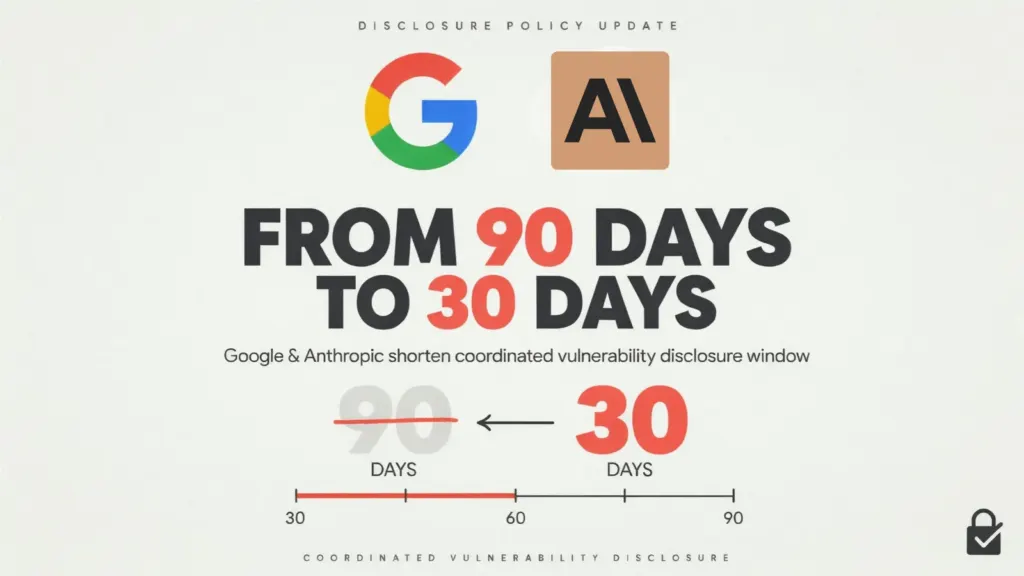
Anthropic will cut the time it gives software makers to fix security flaws reported by its researchers from 90 days to 30 days for high- and critical-severity bugs, and to 45 days for everything else, the company’s Frontier Red Team said on 16 November 2026.
The new deadlines apply to vulnerabilities reported on or after 1 January 2027, and arrive three days after Google Project Zero announced its own move to a 30-day disclosure clock.
The change rewrites the company’s coordinated vulnerability disclosure (CVD) policy, the rulebook that sets how long a bug finder keeps details private while the vendor prepares a patch. In its announcement, Anthropic said the 90-day window made sense when a bug could reasonably stay private for months, an assumption it no longer holds. Frontier AI models have become far better at finding vulnerabilities, and a flaw found by one model is increasingly likely to be found by another.
Anthropic said it is seeing “a higher rate of vulnerability rediscovery,” meaning separate parties are landing on the same bug independently. Every extra week a report sits unpatched is a week in which someone else, including an attacker, may find it too.
What Changes for Maintainers and Vendors
Two other clocks get shorter alongside the main deadline. If a maintainer does not answer an initial report, Anthropic will aim to bring in an external vulnerability coordinator after 15 days instead of 30. Once a patch is available, the company will wait 30 days rather than 45 before publishing full technical details.
Reports already in progress keep their existing deadlines. The exception is a backlog of high- and critical-severity issues that were reported more than 90 days ago, are past their deadline and are still not public.
Anthropic is giving the maintainers of those projects a further 30 days’ notice, after which the reports will be published on its dashboard under the updated policy, starting 1 January 2027.
Some cases will not fit the new windows. Software that is hard to update, such as critical infrastructure, and flaws that need a change to a specification or an RFC will get a remediation timeline agreed with the vendor. The seven-day window for vulnerabilities already being exploited in attacks is unchanged, and the policy does not cover AI-generated findings that no human has reviewed, such as output from Anthropic’s OSS Scanner service.
For open-source projects, many of them run by volunteers, the practical effect is a third of the time to triage, fix and ship a serious bug. Anthropic said each report will carry actionable guidance and, where possible, a patch or mitigation, and that it will agree a sustainable pace with a project before sending it a large volume of findings. Eligible maintainers can also get six months of its Claude Ultra plan at no cost through the Claude for Open Source Program.
How It Compares With Google Project Zero
Google Project Zero scrapped its “90 + 30” policy on 13 November 2026, removing the 30 days of patch “soak time” it had allowed since 2021 for users to install fixes. Its replacement, called Full X, publishes details a fixed number of days after a report, whether or not a fix exists: 90 days now, 60 days from 2 February 2027 and 30 days from 3 January 2028.
Project Zero researcher Natalie Silvanovich wrote that the team now finds “several vulnerabilities a week” in targets where it once found a few a year, and that AI lets attackers reverse engineer a patch into a working exploit quickly enough that soak time no longer protects anyone.
The gradual schedule followed feedback from vendors, who warned that a sudden change could expose unfixed bugs, push lower-severity reports ahead of more serious work, or lead some teams to stop trying to meet deadlines at all.
The two policies share a diagnosis but differ in design. Anthropic reaches a 30-day deadline a full year before Project Zero does, yet it keeps a severity split and a 30-day wait after a patch before releasing full details. Project Zero rejects both ideas, arguing that severity says how badly users are hurt, not how likely an attacker is to find the bug.
Neither organisation has published data showing how many vendors currently fix reported bugs within 30 days. Anthropic’s overdue reports are due to appear on its dashboard from 1 January 2027, which will give the first public measure of how its shorter clock works in practice.
Community Discussion
Join the conversation. Ask questions, share solutions, and help others.
Be the first to start the discussion!