



As of 16 November 2026, Debian has accepted a fixed kernel, linux 6.1.192-2, into its security archive, but it has not reached every architecture’s default kernel package. Systems still on 6.1.192-1 should stay on the previous kernel.
A Debian 12 “bookworm” security update released on 15 November 2026 is freezing servers and desktops within minutes of reboot. The kernel package linux-image-6.1.0-55, shipped as version 6.1.192-1 under advisory DLA 4906-1, crashes inside the ext4 filesystem driver and leaves every process that writes to disk hanging. The problem is tracked as Debian bug #1154101, filed at critical severity.
The first report came from a user identified as Micha, whose mail and web server stopped answering SSH, IMAP, SMTP and HTTP minutes after the update. The machine, an ASUS PRIME H410M-K board with a Core i3-10100T and two SSDs in RAID 1, printed a kernel “Oops” on its console and then locked up. Booting the previous kernel, 6.1.0-54, restored it. Micha’s justification for the critical rating was brief: “breaks the whole system”.
Reports then arrived from almost every kind of deployment. More than a dozen duplicate bugs were merged into the original within a day, covering bare metal, KVM, Xen, Hyper-V and VMware guests on amd64, arm64 and 32-bit x86. Timon de Groot reported the crash on freshly provisioned OpenStack virtual machines while dpkg unpacked a 1 GB package. On the Debian LTS mailing list, Paul van der Vlis said three of the four machines he restarted developed problems.
What is Going Wrong
Every report shows the same signature: a NULL pointer dereference in ext4_mb_load_buddy_gfp, part of ext4’s block allocator, the code that decides where file data lands on disk. The crashing task dies while holding a journal handle, so every later write to that filesystem blocks. The kernel itself keeps running, which is why affected machines may still answer pings while logins, databases and web servers hang.
The cause is a backport. The 6.1 stable kernel series received a change converting the ext4 allocator from pages to folios, the kernel’s newer memory-management unit. In newer kernels the lookup function __filemap_get_folio() returns an error pointer when nothing is cached. In 6.1 it returns NULL, and the backported code only checks for the error pointer. Once the allocator’s bitmap pages are evicted from memory, the next allocation or deletion in that block group crashes.
That explains the uneven timing. Reporters saw failures anywhere from 25 seconds to about five hours after boot, depending on memory pressure. Drew Cohan posted a four-line reproducer that writes 100 small files, drops the page cache and deletes them, which hangs 6.1.192-1 in seconds. Another administrator traced four freezes on two KVM guests to an hourly cron job that drops caches.
The flaw is not Debian-specific. The sporeVM project patched its own kernels for the same crash, which it traced to upstream Linux 6.1.191. Debian’s package bundles the 6.1.191 and 6.1.192 stable releases.
The Fix, and the Catch in Rolling Back
Debian kernel maintainer Salvatore Bonaccorso, who also issued the original advisory, linked the crash to a patch series posted to the linux-ext4 list on 2 November and published an unsigned test build on 16 November. Several reporters confirmed it stopped the crash. A corrected package, 6.1.192-2, was accepted into the oldstable-security archive later that day, according to a message on the LTS list, which added that the follow-up advisory had not yet been issued.
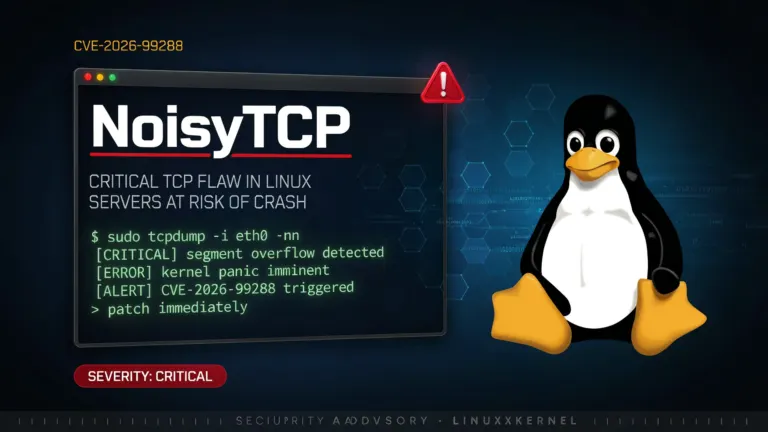
Rolling back carries its own risk. The broken kernel is also the one that fixes CVE-2026-99288, known as NoisyTCP, a flaw that lets a remote attacker crash a Linux machine through any reachable TCP port. Administrators who return to 6.1.0-54 swap a kernel that hangs itself for one that outsiders can knock over, so the hold should last only until the fixed build is installable.
What Debian 12 Users Should Do
Run uname -r. If it prints 6.1.0-55 and the machine uses ext4, reboot, choose “Advanced options for Debian GNU/Linux” in GRUB and select the 6.1.0-54 entry. Machines that have not yet rebooted into the new kernel are not affected until they do.
Then stop apt from pulling the broken build again, and check which version is on offer:
sudo apt-mark hold linux-image-amd64
apt-cache policy linux-image-amd64
Cloud, arm64 and 32-bit systems use differently named packages, such as linux-image-cloud-amd64, and need their own hold. When the candidate version reads 6.1.192-2 or later, release the hold with sudo apt-mark unhold linux-image-amd64, upgrade and reboot. Go by the version number rather than the package name: Russian outlet Tproger, which inspected the repository index on 16 November, found the fixed kernel listed as 6.1.0-56.
Anyone who had to power-cycle a hung machine should check the filesystem and recent backups. Debian had not said by publication time when the regression advisory will be issued or when signed images for all architectures will be available.

Community Discussion
Join the conversation. Ask questions, share solutions, and help others.
Be the first to start the discussion!