

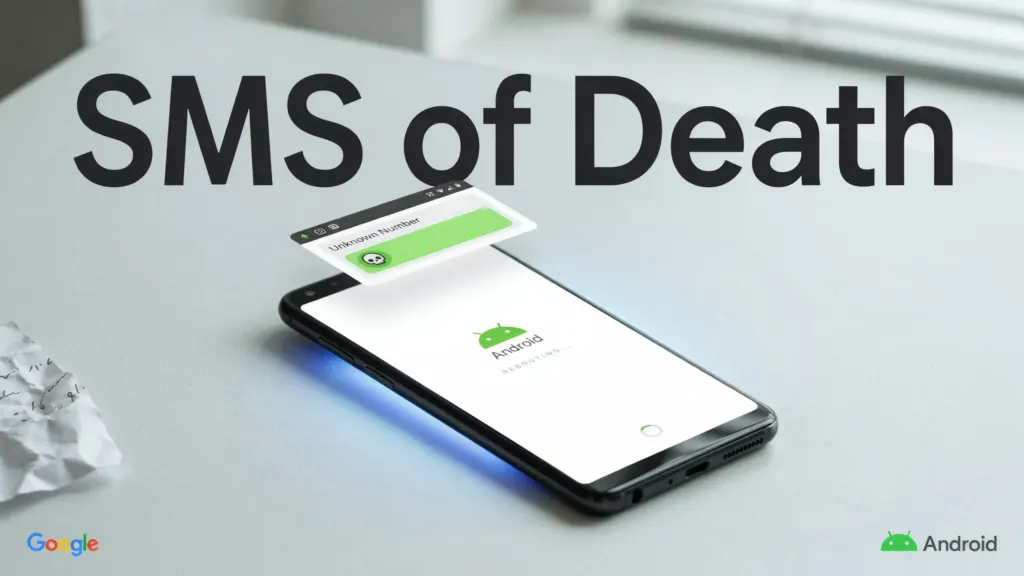
Google wrote a fix for an Android flaw that lets a single invisible text message crash a phone’s calling service months before telling the researcher who reported it that the bug would not be fixed, according to the Android source code and GrapheneOS.
Dubbed SMS of Death, the zero-click denial-of-service bug sits in WapPushOverSms, the part of Android’s telephony framework that processes WAP Push messages. Security researcher Mark Blaszczyk reported it through the Android and Google Devices Vulnerability Reward Program on May 5, 2026, and published full details and a working proof-of-concept on Thursday after Google closed his report as a non-security issue. No CVE identifier has been assigned.
A Google engineer authored a patch on June 15 that is now public in the Android Open Source Project. The commit describes itself as a fix for a remote denial of service in decodeWapPdu, carries a CVE-fix tag, and references an internal Google bug number rather than Blaszczyk’s report.
GrapheneOS said on its issue tracker that the fix went out in Android’s security preview patches, which Google shares with device makers ahead of each monthly bulletin, in mid-July. The privacy-focused Android distribution said it shipped the fix in its own security preview releases that month, and that the patch is part of the upcoming November 2026 Android Security Bulletin.
Until that update reaches them, a single malformed message kills com.android.phone, the system process that runs calling and cellular service, and drops any call in progress, including calls to emergency services. Blaszczyk said he reproduced the crash every time on a Pixel 9 running April 2026 firmware and on several Samsung Galaxy and Galaxy A-series handsets.
How Does One Text Crash an Android Phone?
WAP Push is a decades-old SMS format that carriers use for MMS notifications and configuration messages, and Android parses it automatically. When a WAP Push message arrives, the decoder reads the length of its WSP header as a variable-length integer, gets back a long, and casts it to a 32-bit int without checking the range. That value then sets the size of a new byte array.
// WapPushOverSms.java:217
int headerLength = (int) pduDecoder.getValue32();
// WapPushOverSms.java:244
byte[] header = new byte[headerLength];
A five-byte header length field can encode 0x80000000, which becomes -2,147,483,648 once squeezed into a signed integer. Android then tries to allocate an array of negative size, throws a NegativeArraySizeException on the telephony main thread, and nothing in InboundSmsHandler catches it, so the whole phone process dies. The researcher’s crafted payload is just eight bytes long.
The attack needs nothing from the victim except a phone number. The payload travels as a data SMS addressed to the WAP Push port, so it never lands in the Messages app, shows no notification and never reveals the sender. Each message knocks out cellular service for one to two seconds while the process restarts, and an active call ends with the disconnect cause CS_DEATH.
Why Doesn’t a Factory Reset Fix It?
Because the phone crashes before it confirms receipt, the carrier treats the message as undelivered and keeps sending it again. In Blaszczyk’s testing, a single message caused intermittent outages for up to a week, and about 20 messages left a device unusable for an extended period.
Sending around 30 in rapid succession does lasting damage. The crashes collide with the telephony provider’s writes to the SQLite database that stores SMS messages, and the resulting race condition corrupts it. From then on, com.android.phone crashes on every boot as it reads the damaged store, with no new message required.
A factory reset clears the database, but the carrier redelivers the queued payloads and the cycle restarts. Blaszczyk only recovered his test phones by moving the physical SIM into a non-Android device, such as an iPhone, so the pending messages were acknowledged and stopped coming, then wiping the corrupt SMS records over ADB. He noted that phones using an eSIM, which cannot be moved to another handset, would be far harder to recover, and effectively unrecoverable for most non-technical owners.
The researcher framed the emergency-call risk around Australia, where carriers must identify handsets that cannot reach Triple Zero (000) and cut them off the network. Telstra blocks such devices if the customer does nothing within 28 days. Blaszczyk argued that an attacker who can induce that state remotely could, in effect, get a victim’s own phone barred from service.
What Did Google Tell the Researcher?
Google’s handling of the report spanned three tickets and four engineers, according to the disclosure. The original issue was closed on June 20, five days after the fix was authored, as “Won’t Fix (Infeasible)”, and an appeal filed the same day was closed within three minutes as not reproducible. The report was later marked as duplicate, briefly reopened in July after the issue surfaced on Discord, and sent back to triage after Blaszczyk argued it met the program’s own definition of a destructive remote denial of service.
The final decision came on October 29, two days after Blaszczyk asked for a status update following three months of silence. Google said the bug “does not meet the severity threshold” and classed it as a non-security issue. Blaszczyk had held the details past the program’s 90-day disclosure window and offered to brief Australian carriers before going public.
Google’s patch takes a different route from the single bounds check Blaszczyk proposed on the day of his first report. It widens the error handling in decodeWapPdu to catch any runtime exception, and if processing a message still fails, InboundSmsHandler now deletes the offending message from the raw SMS table instead of crashing. Dropping the poisoned message, rather than retrying it, is what breaks the crash loop, and the unit tests added with the commit include malformed header lengths.
Google has treated a near-identical bug as a security flaw before: in 2009, it patched CVE-2009-2999, a malformed WAP Push message that restarted Android 1.5 phones and dropped them off the network.
The proof-of-concept is an Android app, released with its source code under the Apache 2.0 license, that sends the crafted payload as a data SMS from any Android 11 or later phone with a SIM. Blaszczyk labels it a working weapon for authorized testing only and warns that interfering with someone’s access to emergency services is a serious criminal offence. His disclosure does not report any exploitation in the wild.
GrapheneOS users have been protected since the project’s July security preview releases. Owners of Pixel, Samsung Galaxy, and other Android phones should install the November 2026 security update as soon as their phone maker delivers it.
Updates
2026-10-30: This article has been updated to report that Google authored a fix on June 15 that is now public in AOSP, and that, according to GrapheneOS, the patch shipped in July security previews and is included in the November 2026 Android Security Bulletin. The headline has been updated to reflect this.
2026-10-29: Article published.


Community Discussion
Join the conversation. Ask questions, share solutions, and help others.
Be the first to start the discussion!