



Nearly nine out of ten self-hosted GitHub Enterprise Server instances remain vulnerable to a critical remote code execution flaw that needs nothing more than a standard git client to exploit, according to Wiz Research.
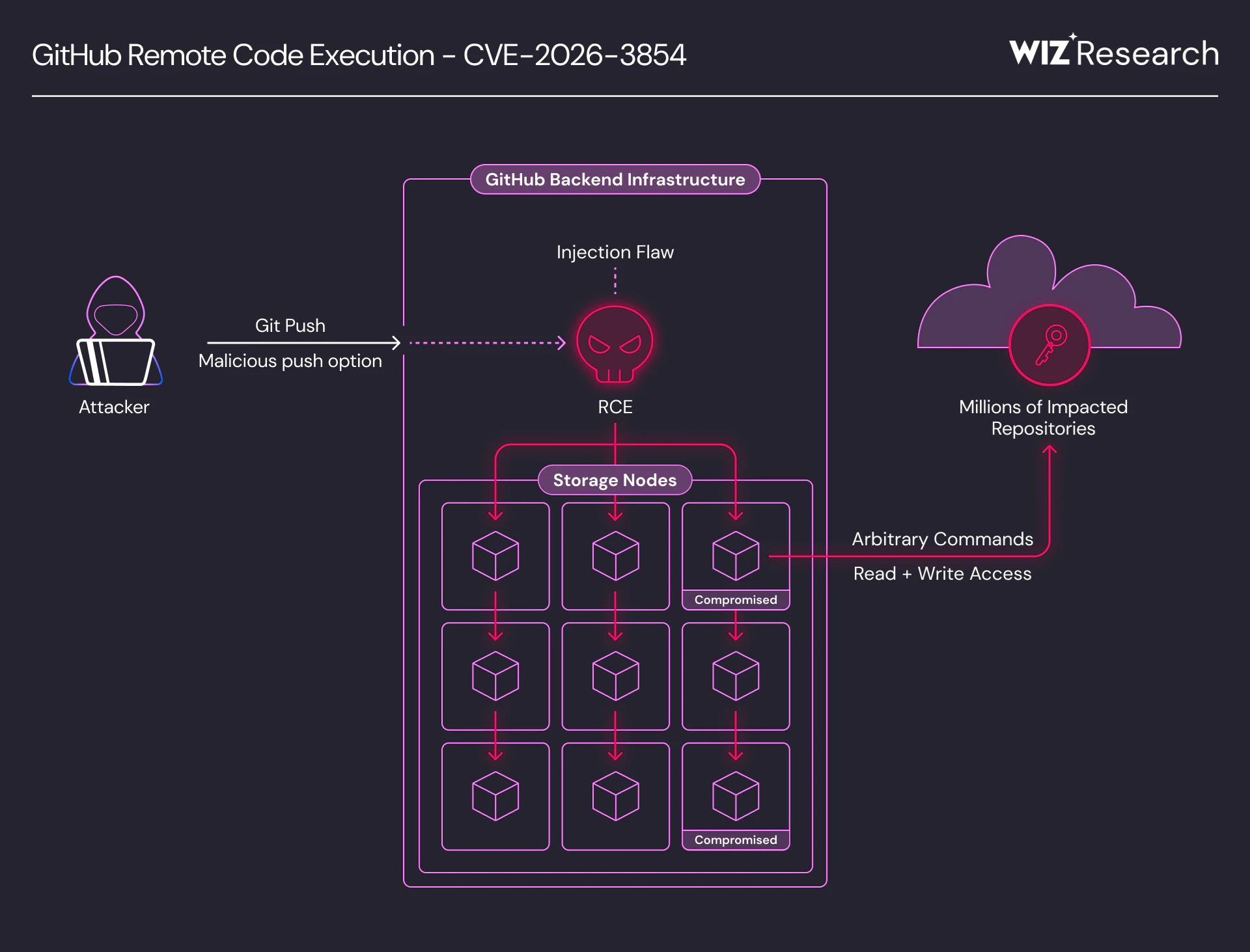
Tracked as CVE-2026-3854, the bug lives in GitHub’s internal git infrastructure and affected both GitHub.com and GHES. Any authenticated user with push access to a repository could run arbitrary commands on backend servers with a single git push.
GitHub shut the loophole on GitHub.com within six hours of Wiz’s report, so cloud users need to do nothing. Administrators running their own servers are the ones now carrying the risk — Wiz’s telemetry indicates 88% of GHES instances are still exposed.
Wiz credits AI-augmented reverse engineering, specifically IDA MCP tooling, with letting its team pull apart GitHub’s compiled closed-source binaries and reconstruct the internal protocols between them. The company had probed GHES before and abandoned the effort as too labor-intensive. This time the binaries gave up their secrets fast enough to map the entire push pipeline.
The flaw itself is almost mundane. When you push code, GitHub’s proxy service passes security metadata to downstream services through an internal header called X-Stat, a list of semicolon-separated key=value pairs.
Push options — arbitrary strings a user supplies with git push -o — get copied into that header without stripping semicolons. Because the parser applies last-write-wins logic, a semicolon in a push option lets an attacker append their own fields that silently override the legitimate ones.
From there, Wiz chained three injected fields to flip the pre-receive hook binary out of its sandboxed production path, redirect the hook lookup directory, and use path traversal to execute an arbitrary file as the git service user.
On GitHub.com, that landed them on shared storage nodes holding millions of repository entries belonging to other tenants. Wiz says it verified permissions using its own accounts only and did not read anyone else’s code.
GitHub CISO Alexis Wales called a finding of this caliber “rare”, noting it earned one of the program’s highest bounty payouts.
What to do: Upgrade GHES to 3.19.3, 3.18.6, 3.17.12, 3.16.15, 3.15.19, or 3.14.24. Anything at or below 3.19.1 is vulnerable.


Community Discussion
Join the conversation. Ask questions, share solutions, and help others.
Be the first to start the discussion!