


OpenAI says an autonomous AI pipeline found, exploited and wrote candidate patches for 948 Linux kernel flaws in a single run in mid-October 2026, at a cost of $1,213,430 in API credits. Each bug is a local privilege escalation (LPE), which lets anyone with an ordinary account on the machine become root. The company published the results on 4 November 2026 in a post titled “A thousand fewer paths to root”.
The post itemises the bill for each of the five stages, which run on an unreleased “upcoming cyber model”. Scout agents spent $3,426 narrowing the kernel to 5,034 audit targets reachable by low-privileged users, about 2.8 million lines or 7% of the code. Analyst agents then produced 2,308 candidate findings in 12 hours for $316,549.
Triage agents reproduced 1,724 of those within 30 hours for $73,330, on a virtual machine running Kernel Address Sanitizer (KASAN), a memory-error detector. Only 3.1% of the failures came from wrong analysis by the model, OpenAI says.
Exploitation took most of the money: $775,929. Agents attacked a stock desktop distribution with SMEP, SMAP, KASLR and HARDENED_USERCOPY protections enabled and produced 1,169 working root exploits and 291 information-leak proofs of concept. Variant analysis reduced those to 948 distinct patches.
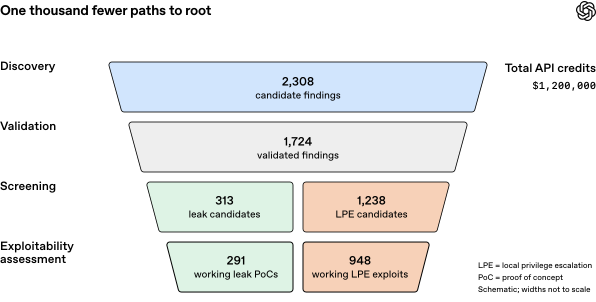
That works out to $1,279 per bug end to end. A successful exploit cost $359 on average to develop, while 69 failed attempts averaged $3,922 each. OpenAI sets this against historical payouts of $20,000 at Pwn2Own and $70,000 at TyphoonPWN for a Linux kernel LPE, and calls its own costs an upper bound. A July run with GPT-5.6 Sol found 166 such bugs for $513,690.
On an adapted version of Google’s hardened kernelCTF target, the pipeline produced 21 LPE exploits in 112 hours for $32,936. kernelCTF has accepted 26 from all researchers in 2026.
The technical detail stops there. The post names no CVEs, subsystems or kernel versions. In a sample of 166 exploits, the agents used ten techniques that were new to OpenAI and to outside kernel experts, including five data-only escalation methods, and the company is withholding them. It does disclose one failure: in an early run, 20 of 200 reported exploits reached root through a different zero-day than the one assigned.
By the time the ten-day scan and review ended, other contributors had patched 61 of the bugs upstream, 43 had staging patches, and 299 were being discussed publicly. OpenAI says it has sent hundreds of reports and patches for critical flaws and will release the rest gradually with its Patch the Planet partners. It does not say how many remain unfixed.
OpenAI’s conclusion is that a low-privileged account on an out-of-date system “should be considered functionally equivalent to root access” for a well-resourced attacker, and it points to sandboxes such as Firecracker and gVisor. The Cloud Security Alliance, in a research note, advised shorter kernel patch windows and cautioned that every figure comes from OpenAI’s own experiment.
The Linux keyring flaw that gives local root was fixed in Linus Torvalds’ tree on 13 October and had reached no stable kernel when a public exploit appeared on 15 November, days after CVE-2026-99288, the NoisyTCP flaw that crashes Linux servers.
Administrators have nothing new to do beyond applying kernel updates promptly. OpenAI has not named the model or said when the remaining reports will reach maintainers.
Community Discussion
Join the conversation. Ask questions, share solutions, and help others.
Be the first to start the discussion!