

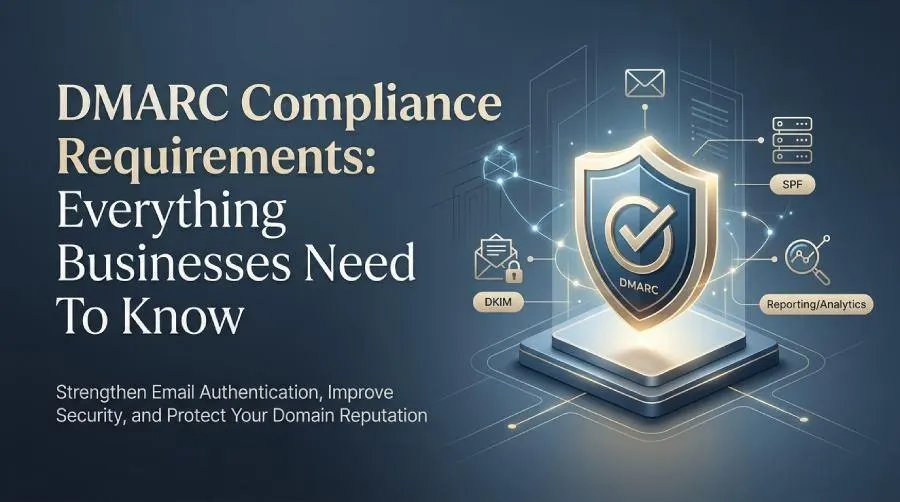
Email remains one of the most important communication channels for businesses, but it is also a common target for spoofing, phishing, and impersonation attacks. DMARC compliance helps organizations strengthen email authentication by working with SPF and DKIM to verify legitimate senders and define how receiving mail servers should handle unauthorized messages.
From publishing accurate DNS records and maintaining identifier alignment to monitoring DMARC reports and gradually enforcing stronger policies, businesses need a structured approach to achieve effective protection. This guide explains the key DMARC compliance requirements, implementation steps, common challenges, and ongoing management practices businesses should know to protect their domains and improve email security.
What DMARC Compliance Means and Why It Matters for Businesses
DMARC compliance represents an organization’s ability to properly implement and maintain Domain-based Message Authentication, Reporting, and Conformance (DMARC) controls to validate outbound emails, protect against spoofing, and secure their domain reputation. At its core, DMARC compliance ensures that every email sent under a company’s domain passes key authentication protocols—namely SPF (Sender Policy Framework) and DKIM (DomainKeys Identified Mail)—and aligns with the DMARC policy published in the DNS records.
Attaining DMARC compliance is vital for businesses looking to protect sensitive information, maintain brand trust, and shield themselves from email-based attacks such as phishing, impersonation attacks, and business email compromise. As digital communications become increasingly targeted by threat actors, DMARC authentication and enforcement have become mandatory for organizations aiming for robust email security and domain authentication.
Moreover, regulatory and industry frameworks, influenced by standards formalized in RFC 7489 by the IETF DMARC Working Group, are increasingly encouraging or requiring businesses to achieve DMARC compliance. This broad push not only mitigates risks of email scams but also enables better reporting, faster detection of misconfigurations, and ongoing protection against spoofing activities.
Core DMARC Requirements: SPF, DKIM, DNS Records, and Policy Alignment
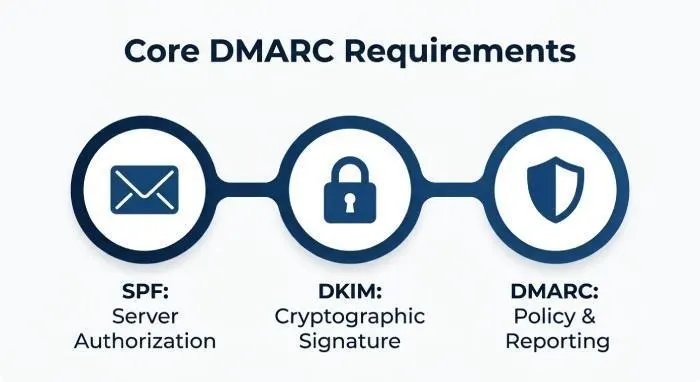
Achieving and maintaining DMARC compliance entails more than simply publishing a DMARC record. The following technical components form the foundation of genuine DMARC readiness:
SPF—Sender Policy Framework
SPF specifies which mail servers are authorized to send email for your domain. The domain owner must publish an accurate SPF record as a TXT record in their DNS. This record lists the IP addresses and servers permitted to send mail. Email servers use this information for sender verification, bolstering defenses against phishing and spoofing.
DKIM—DomainKeys Identified Mail
DKIM applies a cryptographic signature to outgoing email headers, allowing receiving email servers to validate that the content has not been altered in transit and that the message is genuinely from the claimed domain. DKIM signature alignment—ensuring that the “From” domain matches (or is aligned) with the DKIM domain—is a key DMARC requirement.
Publishing a DMARC Record
A valid DMARC record, published as a DNS TXT record, specifies the DMARC policy, reporting endpoints, and compliance preferences for receiving mail servers. A DMARC record typically contains DMARC tags such as p, *rua*, *ruf*, *adkim*, *aspf*, *pct*, *ri*, and others. For example, the p tag sets the DMARC policy (*p=none*, *p=quarantine*, or *p=reject*), while *rua* and *ruf* define where DMARC aggregate reports and forensic reports should be sent.
Adhering to correct DMARC syntax and DMARC standards as outlined in RFC 7489 is critical for policy distribution and effective message validation.
Policy and Identifier Alignment
DMARC requires “identifier alignment,” meaning the domain identifiers used by SPF and DKIM must match (or align with) the domain in the “From” field. This domain alignment is mandatory per DMARC standards and is checked each time an email undergoes DMARC validation.
Subdomain Policy
Enterprises with multiple subdomains should use the sp tag within the DMARC record to define how subdomains are handled. This subdomain policy ensures that even subdomain-based emails are covered by DMARC authentication and enforcement.
How to Implement DMARC: From Monitoring Mode to Enforcement
Implementing DMARC can be divided into three fundamental phases: monitoring, analysis, and full enforcement.
Step 1: Start in Monitoring (p=none) Mode
Initially, DMARC is best deployed with a policy of *p=none*. This allows businesses to collect DMARC aggregate reports and forensic reports—using the *rua* and *ruf* DMARC tags—without affecting the delivery of emails. During this phase, IT teams can use DMARC lookup or DMARC check tool solutions like EasyDMARC, MXToolbox, or the tools referenced on dmarc.org to analyze authentication outcomes and identify potential misconfigurations in SPF or DKIM.
Step 2: Analyze Reports and Adjust Configurations
Aggregate reporting (via XML reports sent to the *rua* email) enables organizations to spot authentication failure trends and verify domain alignment. Forensic reporting (*ruf*) provides detailed information about individual message disposition and aids in identifying spoofing or phishing attempts.
Using DMARC record checker and record testing tools, businesses can troubleshoot DMARC syntax errors, SPF misconfigurations, or DKIM alignment gaps. Domain authentication settings must be continually refined to ensure consistent compliance.
Step 3: Gradually Enforce Stronger Policies (p=quarantine / p=reject)
Once confidence in the configuration is established, organizations should incrementally tighten their DMARC policy to *p=quarantine* (emails that fail DMARC are sent to spam) or full *p=reject* (emails are rejected outright). The process may involve:
- Adjusting the *pct* tag to gradually increase enforcement coverage.
- Updating the reporting interval (*ri* tag) to align with reporting protocol requirements and internal review cycles.
- Ensuring that all legitimate senders are authorized and any third-party vendors are included in the SPF and DKIM records.
DMARC enforcement at *p=reject* delivers the strongest protection against spoofing and is considered the compliance benchmark by security experts, regulators, and consortia like the IETF DMARC Working Group.
Common DMARC Compliance Challenges and How to Avoid Them
Despite clear protocols, businesses often face hurdles while aiming for DMARC validation and compliance. Being cognizant of these pitfalls is crucial for a successful DMARC deployment.
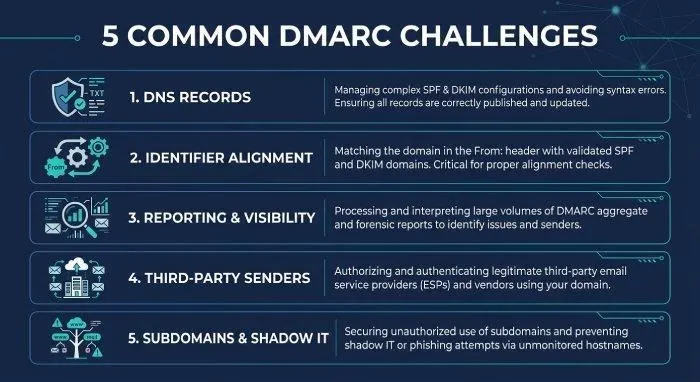
Incomplete or Inaccurate DNS Records
Misconfigured SPF, DKIM, or DMARC records are a common source of authentication failure. Errors in txt record formatting, outdated mail server details, or missing DMARC tags can undermine the entire email authentication ecosystem.
Inadequate Identifier Alignment
Poor coordination between the sender policy framework and DKIM can result in a lack of domain alignment, leading to emails failing DMARC checks even when authentication passes. Close monitoring using a DMARC check tool allows for regular verification and ensures identifier alignment.
Insufficient Reporting and Response Plan
Overlooking DMARC aggregate and forensic reports can leave organizations unaware of fraudulent activities or compliance gaps. A robust compliance action plan should prioritize reviewing XML reports, investigating forensic reporting, and responding to message validation issues quickly.
Third-Party Senders and Policy Distribution
Many businesses rely on third-party platforms. Failure to coordinate policy distribution and ensure third-party authorization in SPF/DKIM records jeopardizes DMARC authentication across the full email ecosystem.
Subdomain Oversight
Not specifying a subdomain policy (sp tag) leaves subdomain emails vulnerable to impersonation attacks and reduces overall brand protection.
Ongoing DMARC Management: Reporting, Audits, and Maintaining Compliance
DMARC compliance is not a one-off project, but an ongoing commitment demanding continuous oversight.
Regular DMARC Record Audits
Routine DMARC lookup and validation—using a DMARC record checker—ensures no new misconfigurations creep in. As the sender or organizational structure changes, DNS records and txt record settings must be kept up-to-date and fully aligned with evolving dmarc policy targets.
Continuous Report Monitoring
Frequent review of dmarc aggregate reports and forensic reports is essential for proactive email security posture management. Monitoring the reporting interval and message disposition outcomes helps organizations identify new risks, track compliance progress, and refine their DMARC enforcement strategy.
Staying Informed on Standards
Staying current with updates to DMARC standards (such as RFC 9989, RFC 9990, and RFC 9991), and referencing leading resources on EasyDMARC, dmarc.org, and Wikipedia ensures that the organization’s dmarc compliance actions are in line with global best practices.
Internal Policy Enforcement and Brand Protection
Comprehensive DMARC deployment enforces effective sender verification, grants protection against spoofing, and assures customers and partners of the organization’s commitment to email security and brand protection. Ongoing training, regular audits, and automated record testing tools should form the backbone of a sustainable dmarc compliance action plan for every business.


Community Discussion
Join the conversation. Ask questions, share solutions, and help others.
Be the first to start the discussion!