


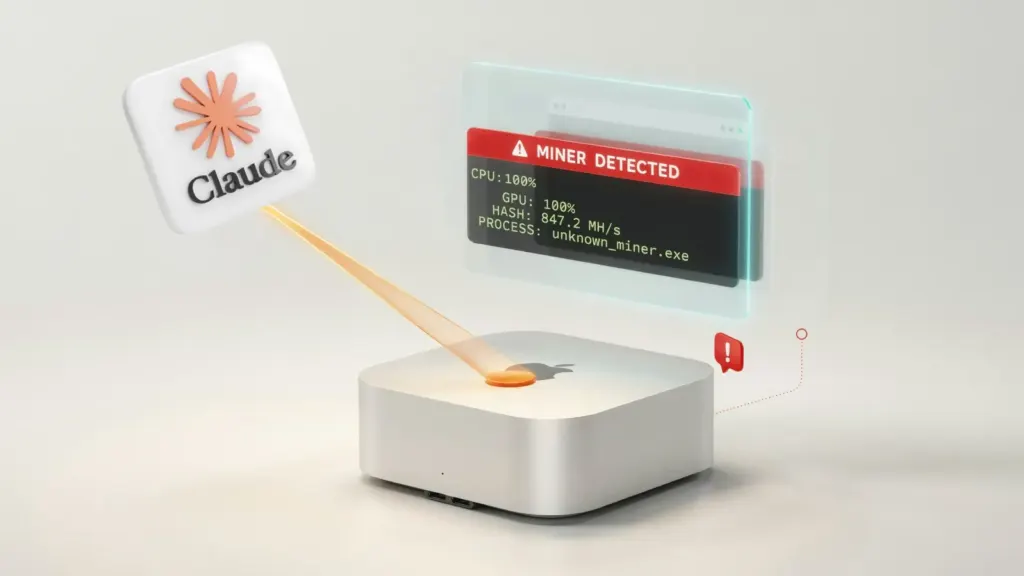
Anthropic’s Claude Code AI agent uncovered a hidden XMRig cryptocurrency miner running on a Reddit user’s Mac while helping to build a temperature-monitoring app, according to a post on Reddit. The miner was consuming about 1,175% CPU, roughly 12 processor cores, and had pushed the chip to a peak of 112°C.
According to the user u/UntilHEX, Claude Code was asked to build a Mac temperature monitor. When the agent dumped the raw sensor readings to check their accuracy, the numbers looked far too high, so it looked at which processes were using the CPU. “Your Mac is running a crypto miner that I didn’t put there,” Claude told the user, according to a screenshot of the session. macOS counts each fully loaded core as 100%, so a reading of 1,175% means close to 12 cores were running flat out.
XMRig is a legitimate open-source miner for Monero, a privacy-focused cryptocurrency that can be mined profitably on ordinary processors. That same property has made it a fixture of cryptojacking, where attackers secretly use someone else’s hardware to mine. In its findings, Claude described how the miner had hidden itself on the Mac and launched at startup.
The screenshot shows more about how the miner stayed alive, according to Wccftech. The miner ran from a temporary folder and sent its work to a mining pool at pool.hashvault.sh. A LaunchAgent, the macOS mechanism that starts programs automatically at login, kept it running through a large encoded script. Its KeepAlive setting tells the system to restart the process whenever it exits, so killing the miner manually would not have stopped it.
Claude did not remove anything on its own. It first asked for permission, proposing to stop the startup item and the miner, and move the files into a quarantine folder. UntilHEX approved the cleanup. In a follow-up comment, the user said they only had to delete one file manually “because Claude had an access issue” and then ran a Malwarebytes scan to confirm the machine was clean.
How the miner got onto the Mac is still unclear
The thread does not establish how the infection started. Responding to other users, UntilHEX blamed cracked audio plugins, though they did not name a specific product. Several commenters noted that Apple’s built-in XProtect signature list already flags XMRig. Gatekeeper, which blocks unsigned apps, should also have stopped a stock copy. Both protections point to a modified or repackaged binary that the user approved manually, but that remains speculation from the thread rather than a finding.
UntilHEX also explained why the load went unnoticed for weeks. The Mac’s fans were not audibly louder; they were wearing headphones, and they often had Blender and FL Studio open, so heavy CPU use did not seem unusual. The user added that they primarily work on Windows.
Mac cryptojacking through pirated software has been documented before. In February 2023, Jamf Threat Labs reported that pirated copies of Final Cut Pro, Logic Pro, and Photoshop shared on The Pirate Bay were installing XMRig. Later versions of that malware shut down the miner whenever Activity Monitor was opened and disguised their processes with system-like names.
At the time, Apple said it would “continue to update XProtect to block this malware.” Jamf warned that the processing power of Apple Silicon makes Macs increasingly attractive targets.
The miner was ultimately exposed by its own heat, caught by a tool being built to measure exactly that.
Mac users who see sustained heat, fan noise, or fast battery drain with nothing heavy open can check for the same problem in three places:
- Run
topin Terminal to see CPU usage. Some miners pause when Activity Monitor opens, so Terminal gives a more reliable reading. - Look for unfamiliar entries in the
~/Library/LaunchAgents,/Library/LaunchAgentsand/Library/LaunchDaemonsfolders. - Review background items under Login Items in System Settings.
Avoiding cracked software and never overriding Gatekeeper for apps from unofficial sources removes the most common route in.
Several questions remain open: which download carried the miner, whether it was active before 29 August, and how much Monero it generated. Monero’s privacy design makes the last of these hard to trace from the outside. Anthropic has not publicly commented on the post.


Community Discussion
Join the conversation. Ask questions, share solutions, and help others.
Be the first to start the discussion!