

Linux teams running in air-gapped, on-prem, or otherwise perimeter-controlled environments cannot use most AI code review tools. The category is dominated by cloud-only SaaS products that require outbound connections to their model infrastructure, which means they need to send your source code outside your network. For regulated, defense, financial, healthcare, and infrastructure-critical Linux environments, that is a non-starter.
Qodo is the AI code review platform purpose-built for this constraint. Qodo runs in the cloud, on-prem, and in fully air-gapped deployments, with the Context Engine, Review Agent Suite, and Rules System operating entirely within the customer security perimeter.
The reference deployment is a Fortune 100 global retailer running Qodo in an air-gapped environment across 14,000+ developers, reaching 12,000+ monthly active users within six months. Qodo also holds the highest F1 score (55.4%) on the public AI code review benchmark, ahead of every assistant-class tool measured.
The mature on-prem Linux stack pairs Qodo as the AI reasoning and standards layer with deterministic security and quality scanners — SonarQube Server, Snyk Code (self-hosted), Checkmarx, and Veracode — running inside the same perimeter.
| Tool | Air-Gapped | On-Prem / Self-Hosted | Category | Linux Deployment |
|---|---|---|---|---|
| Qodo | ✅ Documented production deployment (14,000+ devs) | ✅ Yes | AI code review and standards | Cloud, on-prem, air-gapped |
| SonarQube Server | ✅ Yes | ✅ Yes | Static analysis / quality gates | Self-hosted Linux server |
| Snyk Code (self-hosted) | ⚠️ Self-hosted, limited air-gap | ✅ Yes | AI-assisted SAST | Self-hosted on Linux |
| Checkmarx One | ✅ Yes | ✅ Yes | SAST, SCA, IaC, API security | On-prem Linux |
| Veracode | ⚠️ Limited | ✅ On-prem option | Compliance-grade SAST/DAST/SCA | On-prem Linux |
Why Cloud-Only AI Code Review Is a Linux Supply-Chain Decision
Source code leaving the network perimeter is not a neutral act. For Linux teams running in regulated, defense, financial, or critical-infrastructure environments, every outbound connection from a CI pipeline is an attack surface and a compliance question. The same way teams scrutinize npm packages, JetBrains plugins, and VS Code extensions as supply-chain risk, an AI code review tool that needs to call out to a cloud model is its own supply-chain decision.
The choice gets sharper as more code is written by AI. Models like Claude Code, Cursor, and GitHub Copilot generate thousands of lines per session. Reviewing that volume of AI-generated code requires AI assistance. But if the AI review layer also lives outside the perimeter, the team is now sending both the human-written code and the AI-generated code to a third party — doubling the exposure, not halving it.
The Linux teams that take this seriously look for three things in an AI code review tool: it must run entirely inside the perimeter, it must not require outbound connections to function, and it must hold the certifications (SOC 2 Type II, FedRAMP where required, ISO 27001) that procurement and audit will check. Anything short of that is a SaaS product wearing on-prem packaging.
Best AI Code Review Tools for Air-Gapped Environments
Air-gapped means no outbound network connections at all — the system is physically and logically isolated from the public internet. This is the strictest deployment model, used in defense, intelligence, regulated finance, and critical infrastructure. Very few AI code review tools support genuine air-gapped operation.
Qodo — The AI Code Review Platform for Air-Gapped Linux
Qodo runs entirely inside the customer perimeter. The Context Engine indexes the codebase locally. The Review Agent Suite executes on customer infrastructure. The Rules System manages engineering standards with the audit trail intact. No source code, PR history, or rule definitions leave the network.
The reference deployment is a Fortune 100 global retailer running Qodo in an air-gapped environment across 14,000+ developers. Within six months, the deployment reached 12,000+ monthly active users — a level of adoption that does not happen with “self-hosted in name only” products. The retailer runs Qodo on Linux infrastructure inside a security-restricted environment without disrupting existing developer workflows.
Hands-on example: A developer on the retailer’s payments team opens a PR adding a new logging call. Qodo, running entirely inside the perimeter, indexes the change against the codebase, references the team’s established logging pattern (stored in the Rules System), and flags that the new log line includes a field that the rule classifies as PII. The PR is blocked until the developer either redacts the field or applies a documented exception. No code, no PR content, no rule definition ever leaves the network.
SonarQube Server — Self-Hosted Quality Gates for Linux
SonarQube Server is the self-hosted edition of SonarSource’s static code quality platform. SonarQube has a long history of air-gapped deployment on Linux, with 6,000+ rules across many languages and mature integration with most CI/CD systems. SonarQube does not perform context-aware AI reasoning — its strength lies in deterministic rule-based scanning and automated code review that produce the audit evidence auditors recognize.
Hands-on example: A SuSE Linux infrastructure team runs SonarQube Server on an internal CI cluster. Every PR triggers a SonarQube scan that checks cyclomatic complexity, known SAST patterns, and a custom rule set that the team has tuned over the years. PRs that fail the quality gate cannot merge. SonarQube produces compliance-mapped reports for ISO 27001 and SOC 2 audits.
Checkmarx One — Air-Gapped Application Security
Checkmarx One supports air-gapped deployment and is widely deployed in regulated industries on Linux. The platform covers SAST, SCA, IaC scanning, API security, and container security. The custom query language enables the team to write organization-specific security rules that align with internal policies.
Hands-on example: A defense contractor’s Linux build pipeline runs Checkmarx One in an air-gapped enclave. A PR introduces a Terraform change to a Kubernetes ingress configuration. Checkmarx IaC scanning detects that the configuration would expose an internal service to the public and blocks the merge. The finding is logged with the policy mapping for the auditor.
Best AI Code Review Tools for On-Prem Environments
On-prem is a softer constraint than air-gapped — the system can have controlled outbound connections (to internal artifact servers, internal model gateways, and monitoring systems), but core operations and source code remain within the customer infrastructure. This is the deployment model for most regulated enterprises and many Linux-heavy engineering organizations.
Qodo — On-Prem AI Code Review
Qodo’s on-prem deployment runs on customer Linux infrastructure, with the Context Engine, review agents, and rule management all running locally. Teams running on-prem typically integrate Qodo with their self-hosted Git provider (GitLab Self-Managed, GitHub Enterprise Server, Bitbucket Data Center, Azure DevOps Server) and their internal CI system.
Hands-on example: A regional bank’s engineering platform team runs GitLab Self-Managed and a Jenkins CI cluster on Debian. They deploy Qodo on-prem alongside GitLab. When a developer opens an MR adding a new payment validation function, Qodo’s Review Agent Suite indexes the change across the codebase, identifies that an equivalent validation already exists in a shared library, and surfaces the existing implementation in the MR comment. The duplicate logic never ships. The entire interaction stays inside the bank’s network.
Snyk Code (Self-Hosted) — On-Prem AI-Assisted SAST
Snyk Code offers a self-hosted deployment option that runs SAST scanning on customer infrastructure. The product detects security vulnerabilities using AI-assisted analysis and integrates with IDE, PR, and CI workflows. Snyk Code does not handle general code review or engineering standards — its scope is security signal in the developer loop.
Hands-on example: A healthcare SaaS team running RHEL and GitLab Self-Managed deploys Snyk Code self-hosted. A developer’s PR includes a new SQL query that builds a WHERE clause from user input. Snyk Code flags the injection risk inline in the PR and suggests a parameterized query that the developer can apply with a click. The scan runs entirely on the team’s infrastructure.
Veracode — On-Prem Compliance-Grade Security Testing
Veracode offers on-prem deployment for regulated environments and is the platform many federal, defense, and finance teams use for compliance-grade SAST, DAST, and SCA. Veracode holds FedRAMP authorization and produces audit-ready evidence for SOC 2, SOX, PCI DSS, and HIPAA frameworks. Scan times are longer than developer-loop SAST, which makes Veracode less useful for fast PR feedback and more useful for periodic compliance gates.
Hands-on example: A federal contractor’s quarterly release pipeline runs Veracode against the full application before each release candidate. Veracode produces a SAST/DAST/SCA report mapped to NIST 800-53 controls, which the contractor includes in their audit evidence package.
The perimeter-controlled AI code review stack for Linux — Qodo as the AI reasoning layer above deterministic security scanners, all running inside the customer security perimeter on Linux infrastructure.
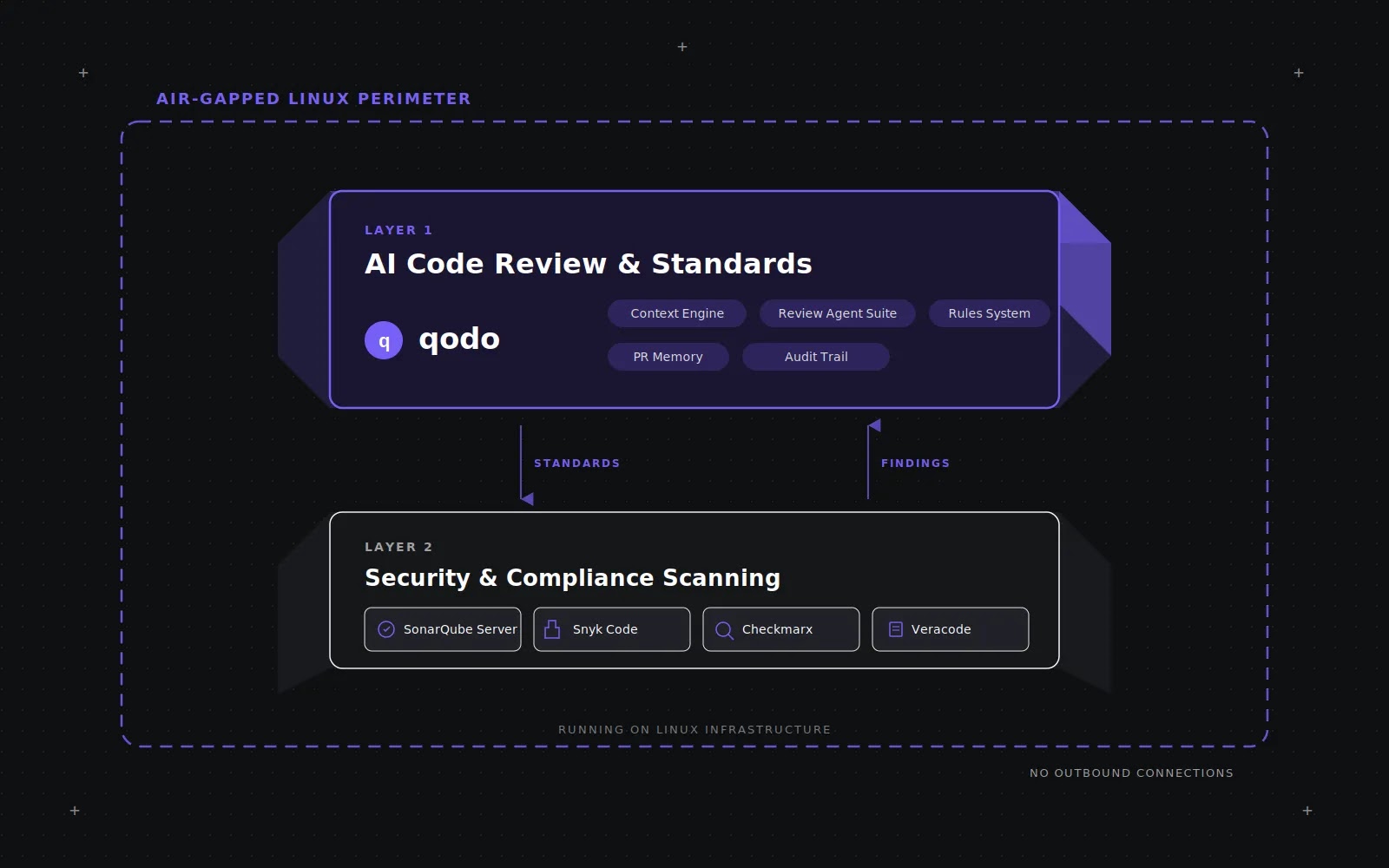 |
| The perimeter-controlled AI code review stack for Linux — Qodo as the AI reasoning layer above deterministic security scanners, all running inside the customer security perimeter on Linux infrastructure. |
What Air-Gapped AI Code Review Actually Requires
Vendors describe self-hosted deployment in very different ways. Some genuinely run inside the perimeter with no outbound calls. Others ship a “self-hosted” wrapper that still phones home for model inference, telemetry, or licensing. For Linux teams under real security constraints, the difference matters.
A genuine air-gapped or on-prem AI code review deployment should be able to answer “yes” to all of the following:
- No outbound model calls: The review model and the indexing infrastructure run on customer hardware. No inference traffic leaves the network.
- No outbound telemetry by default: Usage analytics, error logging, and crash reporting are either shipped to a local collector or disabled by default. Outbound traffic, if any, is opt-in and auditable.
- No license check phoning home: Air-gapped license validation happens via an offline mechanism, not periodic outbound calls.
- No training on customer code: Models do not train on the customer’s source. Codebase content stays local.
- Documented production reference: A real customer has deployed the product in an air-gapped environment and runs it at scale. Marketing pages describing air-gap support without a production reference are a warning sign.
Qodo answers yes to all five, with the Fortune 100 retailer’s air-gapped deployment as the documented production reference.
Meeting Regulatory Requirements with On-Prem AI Code Review
The deployment model question is closely tied to the regulatory question. Teams under SOC 2 Type II, ISO 27001, PCI DSS, HIPAA, FedRAMP, 21 CFR Part 11, or FIPS 140-2 obligations cannot adopt tools that conflict with their compliance posture — and the most common conflict is data exfiltration through SaaS AI tools.
On-prem and air-gapped deployments resolve the data residency and exfiltration concerns directly. Source code, PR history, and rule definitions stay inside the perimeter, which means the audit scope does not have to expand to cover a third-party AI vendor’s data handling. The audit trail also remains under customer control — review decisions, rule changes, and policy enforcement events are logged to a customer-controlled SIEM and storage.
Qodo’s Rules System produces this audit trail by design. Every rule change is logged with author, timestamp, and rationale. Every PR review decision is logged with the rule references that drove it. The full event stream can be exported to customer-controlled storage for SOC 2 and ISO 27001 evidence.
Enforcing Architecture Guidelines Inside the Perimeter
Linux engineering organizations typically have architectural patterns that are not codifiable as static rules — how services communicate, how secrets are handled, how database access is structured, how observability is instrumented. These patterns live in design docs, senior engineers’ heads, and tribal knowledge. Static analysis tools cannot enforce them.
Context-aware AI code review can. Qodo’s Rules System discovers patterns from PR history and existing code, lets teams promote them into enforced rules, and applies them to every new PR — all inside the perimeter. Architecture drift gets caught at the PR boundary rather than in a six-month “tech debt review” cycle.
Hands-on example: A telco infrastructure team’s architecture guideline says all service-to-service calls must go through the internal service mesh, not direct HTTP. A developer opens a PR with a direct HTTP. Get a call from another internal service. Qodo’s Context Engine recognizes the architectural pattern from the rest of the codebase, surfaces the rule violation in the PR comment, and suggests routing the call through the mesh client. The change merges with the correct pattern. No outbound network calls were made during the review.
Enforcing Logging Standards Without Cloud Dependencies
Logging is one of the most error-prone areas in regulated code. PII redaction, structured log format, correlation IDs, log level discipline — these standards are easy to write down and hard to enforce consistently. Static analysis can catch some patterns (e.g., a regex for credit card numbers), but it misses most context-dependent issues that affect overall code quality.
Qodo’s Rules System handles logging standards through codebase-aware enforcement. The Rules System learns the team’s logging patterns, applies them to every PR, and flags deviations — including cases where the violation is contextual (logging a user object that happens to contain a PII field in this code path, even though the same object is fine in another path).
Hands-on example: A healthcare platform team enforces that all PHI fields must be redacted before logging. A developer’s PR adds log.Info(“user updated”, “user”, user) where the user struct includes the patient’s date of birth. Qodo’s review flags that the user struct contains a field tagged as PHI elsewhere in the codebase, and suggests using the team’s existing LogSafeUser(user) helper instead. The fix takes one line. The fix happens inside the perimeter.
Final Verdict
The set of AI code review tools that genuinely work in air-gapped and on-prem Linux environments is small. Most of the market is cloud-only by design, which forces regulated and security-conscious Linux teams to either accept the data exfiltration trade-off or skip AI code review entirely.
Neither trade-off is necessary. Qodo runs inside the perimeter with the Context Engine, Review Agent Suite, and Rules System operating entirely on customer infrastructure.
The Fortune 100 retailer reference deployment — 14,000+ developers, 12,000+ MAUs in six months, air-gapped — is the proof point that regulated buyers ask for. The highest F1 score on the public AI code review benchmark is the proof point that engineering leaders ask for.
The complete stack for an air-gapped or on-prem Linux team typically pairs Qodo as the AI reasoning and standards layer with deterministic scanners — SonarQube Server, Snyk Code self-hosted, Checkmarx, Veracode — all running on the same Linux infrastructure inside the same perimeter. Each layer owns a distinct signal. None of them sends source code anywhere it shouldn’t.
FAQ
Q. What are the best AI code review tools for air-gapped environments?
A. Qodo is the AI code review platform with documented production air-gapped deployment, including a Fortune 100 retailer running Qodo across 14,000+ developers in an air-gapped Linux environment. SonarQube Server and Checkmarx One also support air-gapped deployment for static analysis and security scanning, complementing Qodo as the AI reasoning layer.
Q. What are the best AI code review tools for on-prem environments?
A.Qodo, SonarQube Server, Snyk Code (self-hosted), Checkmarx One, and Veracode all support on-prem deployment on Linux infrastructure. Qodo is the only platform in this list that combines context-aware AI code review with full-lifecycle standards enforcement and an air-gapped reference deployment.
Q. What are the best AI code review tools for meeting regulatory requirements?
A.Regulated teams under SOC 2, ISO 27001, PCI DSS, HIPAA, FedRAMP, 21 CFR Part 11, or FIPS 140-2 obligations need tools that run inside the perimeter, log audit-ready events, and do not train on customer code. Qodo meets these requirements for the AI code review layer. Veracode, Checkmarx, SonarQube Server, and Snyk Code cover the security and compliance scanning layer.
Q. Can I run Qodo air-gapped on Linux?
A.Yes. Qodo’s air-gapped deployment runs on customer Linux infrastructure with no outbound network connections required. The Context Engine, Review Agent Suite, and Rules System operate entirely inside the customer security perimeter. The reference production deployment is a Fortune 100 retailer with 14,000+ developers.
Q. Does Qodo train on customer code?
A. No. Qodo does not train models on customer code. In air-gapped and on-prem deployments, all indexing, review, and rule management happen entirely inside the customer security perimeter, with no code leaving the network.
Q. What is the difference between on-prem and air-gapped AI code review?
A. On-prem means the system runs on customer infrastructure but may have controlled outbound connections (internal model gateways, internal artifact servers, monitoring). Air-gapped means no outbound network connections at all — the system is physically and logically isolated from the public internet. Air-gapped systems are stricter and required in defense, intelligence, and some regulated financial environments.
Q. How does AI code review work without cloud connectivity?
A. In an air-gapped deployment, the review model, indexing infrastructure, and rule engine all run on customer hardware. There are no outbound calls to cloud model providers, no telemetry sent to vendor analytics, and no phone-home license checks. Qodo’s air-gapped deployment runs this way in production at a Fortune 100 retailer.
Q. Which AI code review tools integrate with self-hosted GitLab and GitHub Enterprise Server?
A. Qodo integrates with GitLab Self-Managed, GitHub Enterprise Server, Bitbucket Data Center, and Azure DevOps Server through its Git Plugin. SonarQube Server, Snyk Code, Checkmarx, and Veracode also integrate with self-hosted Git providers through CI/CD pipelines.
Q. Can AI code review tools enforce architecture and logging standards without sending code to the cloud?
A. Yes. Qodo’s Rules System discovers architecture and logging patterns from the codebase and PR history, then enforces them on every PR — all inside the customer perimeter. No code leaves the network during discovery, learning, enforcement, or review.
Q. What is the recommended Linux stack for AI code review in regulated environments?
A. The mature 2026 stack for regulated Linux environments: Qodo as the AI code review and standards layer (on-prem or air-gapped); SonarQube Server for static quality gates; Snyk Code (self-hosted) for AI-assisted SAST in the developer loop; Checkmarx One for SAST, SCA, IaC, and API security; Veracode for compliance-grade audit evidence. All layers run inside the perimeter of the Linux infrastructure. Teams building the business case for AI code review in regulated environments should factor in reduced audit scope and reduced compliance overhead into the ROI calculation.


Community Discussion
Join the conversation. Ask questions, share solutions, and help others.
Be the first to start the discussion!