


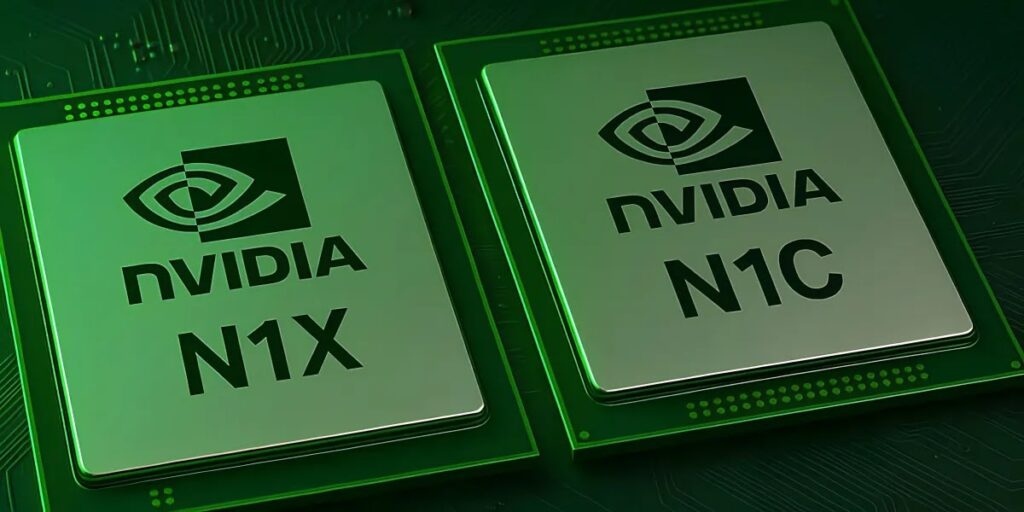
Nvidia has spent years teasing its way into the laptop market, and now — one day before Jensen Huang takes the Computex stage in Taipei — a Geekbench result from a mystery HP prototype gave the internet its first look at N1X CPU performance.
But that benchmark leak has just been overshadowed by something more revealing: a full four-SKU spec sheet for the entire N1 family, courtesy of Videocardz, sourced from documents dating back to 2024.
Together, the two leaks paint a clearer picture than either does alone. The Geekbench result tells you where the top-end chip lands on CPU throughput. The spec sheet tells you what you’re actually buying at each price point — and reveals that Nvidia’s Windows PC ambitions span a much wider range than the single flagship chip most coverage has focused on.
Four chips, not two
The N1 family splits into two product lines with two SKUs each. The premium N1X targets performance laptops and mobile workstations at a projected $2,000-plus price point, directly competing with the MacBook Pro. The mainstream N1 aims at the sub-$1,500 midrange — an area where Qualcomm’s Snapdragon X Elite has struggled to find traction despite strong efficiency credentials.
Full N1 Family Specification Comparison
| Model | CPU Cores | GPU (CUDA) | PCIe Lanes | Memory | TDP |
|---|---|---|---|---|---|
| N1X (1) — GB10 | 20 (10P + 10E) | 6,144 | 12× PCIe 5.0 + 5× PCIe 4.0 | 16GB–128GB / 16-channel | 45–80W |
| N1X (2) | 18 (9P + 9E) | 5,120 | 12× PCIe 5.0 + 5× PCIe 4.0 | 16GB–128GB / 16-channel | 45–80W |
| N1 (1) | 12 (8P + 4E) | 2,560 | 8× PCIe 5.0 + 3× PCIe 4.0 | 8GB–64GB / 8-channel | 18–45W |
| N1 (2) | 10 (7P + 3E) | 2,048 | 8× PCIe 5.0 + 3× PCIe 4.0 | 8GB–64GB / 8-channel | 18–45W |
The N1X flagship is a rebranded GB10 — that’s a big deal
The top-end N1X (20-core, 6,144 CUDA cores) is not a new design. Jensen Huang already confirmed it is the same GB10 silicon found inside Nvidia’s DGX Spark — a $3,000 mini-PC positioned as a personal AI supercomputer. Putting that chip inside a consumer Windows laptop is a different proposition entirely.
The GB10 in the DGX Spark runs at a fixed power envelope; in a laptop chassis with thermal constraints and a battery to preserve, achieving the same throughput will require careful firmware and thermals work from OEM partners.
The N1X also arrives in an 18-core (9+9) variant with 5,120 CUDA cores — the same TDP range of 45W to 80W, but presumably hitting lower sustained clocks and with modestly less GPU compute. Both N1X SKUs share a generous connectivity spec: 12 PCIe 5.0 lanes, 5 PCIe 4.0 lanes, and support for up to three M.2 SSDs.
What the Geekbench leak tells us — and doesn’t
The benchmark result uploaded on June 10, 2025, from an HP 8EA3 prototype running Ubuntu 24.04.1 LTS represents the top N1X SKU: 20 cores, 119.59 GB reported (128 GB LPDDR5X), at 2.81 GHz base frequency. It scored 2,821 single-core and 17,152 multi-core on Geekbench 6.
| Chip | Single-Core (GB6) | Multi-Core (GB6) |
|---|---|---|
| Nvidia N1X (Linux, pre-prod) | 2,821 ★ | 17,152 ★ |
| AMD Ryzen AI MAX+ 395 | 3,125 | 21,035 |
| Intel Core Ultra 9 285HX | 3,078 | 22,104 |
| Qualcomm Snapdragon X Elite | 2,693 | 13,950 |
| Apple M4 Max (macOS) | 4,054 | 25,913 |
The critical caveat: this result is from Linux, not Windows. ARM chips consistently score higher on Linux than on Windows 11 due to overhead from the x86 emulation layer (Prism) and immature Windows-side driver stacks.
When Qualcomm’s Snapdragon X Elite was benchmarked on Linux before launch, it too posted scores that did not carry over to shipping hardware. The N1X multi-core result sits roughly 10–15% behind AMD’s Ryzen AI MAX+ 395 and Intel’s Core Ultra 9 285HX — but both those chips were benchmarked on Windows 11, not Linux, further skewing the apparent gap.
Memory: 8,533 MT/s could be the quiet headline
The N1X supports 16 LPDDR5X channels versus the base N1’s 8, and a previous leak suggests both families are running memory at 8,533 MT/s.
That would make N1X’s memory subsystem faster than AMD’s Strix Halo platform in raw bandwidth terms — a potentially significant advantage for the GPU workloads and local AI inference scenarios where memory bandwidth is the primary bottleneck. The N1 tops out at 64 GB; the N1X can scale to 128 GB, making it competitive with Apple’s top-tier MacBook Pro configuration.
Why this matters more than the benchmark scores suggest
CPU figures are the least interesting part of the N1X story. Every Windows ARM chip benchmarks respectably on CPU throughput. What none of them have offered — until now — is a genuine CUDA-capable GPU in a thin laptop form factor.
The N1X’s Blackwell GPU with 6,144 CUDA cores is estimated to land between RTX 4070 and RTX 5070 laptop performance in compute workloads, and it brings the full CUDA software stack: PyTorch, TensorRT, RAPIDS, and every other Nvidia-ecosystem AI tool that developers have been locked to data centers or thick gaming laptops to access.
This is Nvidia’s second attempt at an ARM-based PC chip. The first came in 2011, then again with Windows RT tablets in 2012 — both efforts stalled due to software ecosystem immaturity. The difference in 2026 is that the software ecosystem has reorganized itself around Nvidia’s CUDA toolchain. Developers don’t need to be convinced to support it; they already depend on it.
“From an industry perspective, it’s a good thing. Qualcomm has struggled to grab a significant chunk of the PC market despite offering excellent battery life, in part because developers didn’t see a need to focus scarce resources on a somewhat different version of Windows.” — Carolina Milanesi, analyst at Current Strategies, speaking to Axios
Which laptops are coming and at what price
Dell XPS, Lenovo Legion 7, ASUS ProArt, and Microsoft Surface have all signaled N1X or N1 variants ahead of the show. With the N1 family’s TDP floor at 18W, ultrabook-class devices are feasible alongside workstation replacements running at 80W.
The sub-$1,500 N1 tier in particular could be genuinely disruptive if OEMs price it competitively — it offers more GPU compute than anything Qualcomm or Intel currently puts in that category.
The one unsolved variable is pricing during what Videocardz describes as an ongoing RAM supply crunch. A 128 GB LPDDR5X configuration at 8,533 MT/s will not be cheap. Nvidia has never competed primarily on price, and it will not start now. The question is whether the CUDA premium justifies the premium ticket — and for developers and AI-native workloads, the answer is likely yes.



Community Discussion
Join the conversation. Ask questions, share solutions, and help others.
Be the first to start the discussion!