



An OpenAI engineer has been charged with hiding a covert audio recorder in an executive conference room at the company’s San Francisco offices, the US Justice Department said. Abdulrahman Alfozan, a 35-year-old Saudi national who had worked at OpenAI since July 2025, was arrested on 9 October and charged with using, or attempting to use, a device to intercept oral communications — a charge that carries up to five years in prison.
The hiding spot was almost comically analogue. According to the criminal complaint, OpenAI staff found the recorder on 30 September, plugged into a USB port on the back of a television and wrapped in toilet paper. The company determined it had been installed around 28 September and that everything it captured was encrypted.
OpenAI told Fortune that its technical surveillance countermeasures team — the people whose job is sweeping rooms for bugs — found it during a sweep, and described the device as built to evade detection, with advanced encryption, live audio monitoring and a data-transfer method designed to slip past network monitoring.
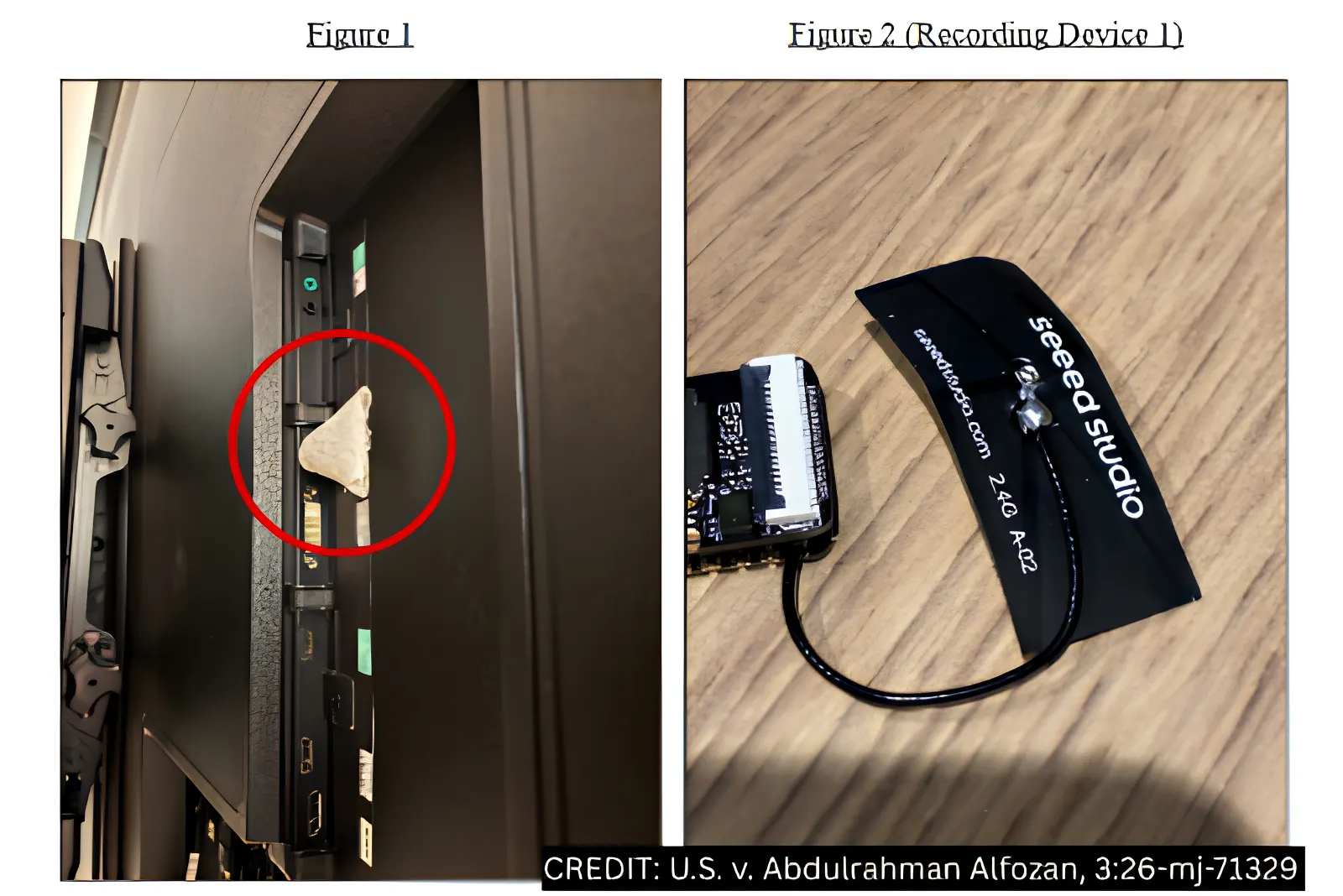
The room mattered. Prosecutors say meetings there routinely covered proprietary research, product plans, business deals and nonpublic details of OpenAI’s capabilities, government engagements and commercial relationships. Alfozan had no authority to attend any of them, yet CCTV footage placed him near the room on multiple dates before the device turned up.
A chatbot, a MAC address and a second recorder
The complaint leans heavily on Alfozan’s digital trail. Before 28 September, he allegedly used a productivity tool to look up OpenAI’s building addresses, meeting-room calendars and capacities, where “leadership and exec” sat, and when external partner meetings were happening.
Between 24 and 30 September, a chatbot account linked to his spouse — which prosecutors say shared multiple identifiers with Alfozan’s own account — allegedly asked how to build a continuous audio recorder, improve live listening, customise Wi-Fi connectivity, and encrypt an SD card.
On 27 and 28 September, the same account asked about the specific device later found behind the TV, including its custom header and unique MAC address. The complaint does not name which chatbot was used.
On 5 October, CCTV allegedly caught Alfozan walking back into the conference room and peering behind the television. By then, the device was already gone. The same day, he allegedly left a bag unattended in another room; OpenAI security opened it and found his wallet, his ID and a second recorder resembling the first.
That 5 October visit came after OpenAI said it had already moved against him. The company told Fortune it spent the period between 30 September and 9 October coordinating with the FBI on the timing of his termination and, in the meantime, restricted his office and system access, suspended his network access, placed him on leave, and took his company equipment. How he still managed to reach the executive room has not been explained.
What OpenAI and the government are saying
OpenAI confirmed the arrest in a post on X, saying it used its own models to analyse the device and identify the employee who planted it before referring the case to the FBI.
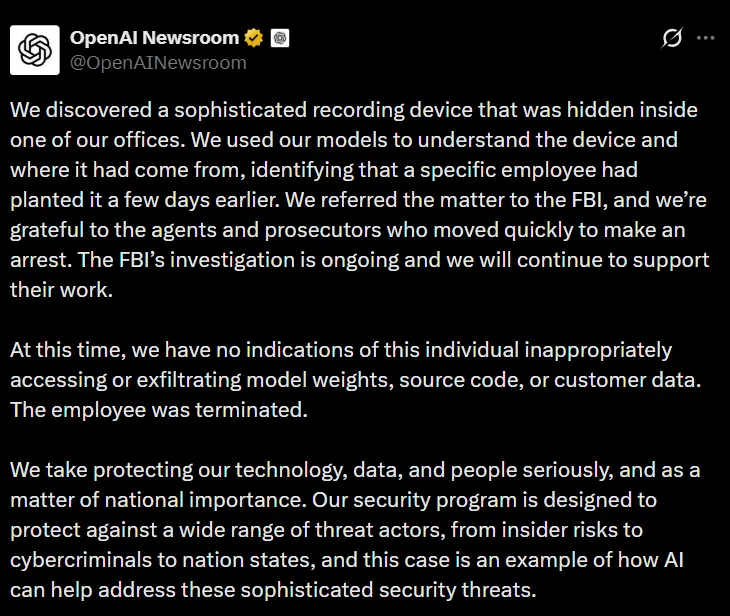
The company said it has “no indications” that Alfozan accessed or exfiltrated model weights, source code or customer data, and that he has been fired. Neither OpenAI nor the FBI has said that any recorded material left the building.
Washington is framing the case well beyond workplace snooping. FBI Director Kash Patel said Alfozan allegedly tried to capture conversations about the company’s “super intelligence technology,” and called protecting that work one of the bureau’s top counterintelligence priorities.
Director of National Intelligence Jay Clayton tied the arrest to the “global super intelligence race.” The case is being prosecuted by the US Attorney’s Office for the Northern District of California with help from the National Security Division’s Counterintelligence and Export Control Section, and the Justice Department says it supports National Security Presidential Memorandum 11 (NSPM-11), a directive aimed at keeping the US ahead in superintelligence technology.
Yet the charge itself is a wiretapping offence, not espionage or trade-secret theft, and the public filing does not allege that Alfozan was working for any government or outside party. It also leaves the most obvious question open: who, if anyone, the recordings were meant for.
There is a neat symmetry to the alleged facts — a chatbot reportedly helped design the bug, and OpenAI says its models helped trace it back to its owner.
The arrest occurred less than two weeks after OpenAI fired three AI safety researchers for mishandling sensitive company information, a separate dispute that the researchers have publicly contested. Nothing in the complaint connects the two cases.
Alfozan made his first appearance in federal court in San Francisco on 13 October and is due back on 19 October for a detention hearing, according to Fortune. He could not be reached for comment, and no defence attorney was listed in the Justice Department’s announcement. If convicted, he faces up to five years in prison, a $250,000 fine and three years of supervised release. The charges are allegations, and he is presumed innocent unless proven guilty.


Community Discussion
Join the conversation. Ask questions, share solutions, and help others.
Be the first to start the discussion!