

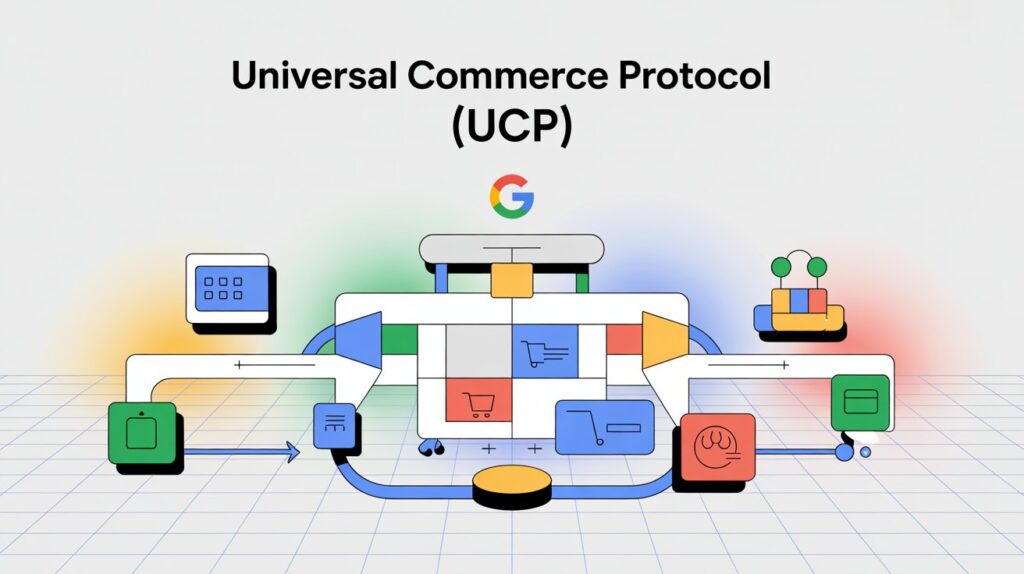
Google wants to eliminate the friction between thinking “I need that” and actually buying it—and they’re doing it by teaching AI assistants across the internet to speak the same language. The tech giant unveiled the Universal Commerce Protocol this week at the National Retail Federation conference in New York, a new open standard that could fundamentally reshape how we purchase products through AI-powered conversations.
If you’ve ever chatted with ChatGPT about finding a suitcase or asked Gemini for gift ideas, you’ve likely encountered the same issue: great recommendations, but then you’re clicking on links and filling out checkout forms on various websites.
UCP aims to eliminate that barrier by creating a standardized way for AI assistants, retailers, and payment providers to communicate with each other—from product discovery through to purchase confirmation.
What Is Universal Commerce Protocol (UCP)?
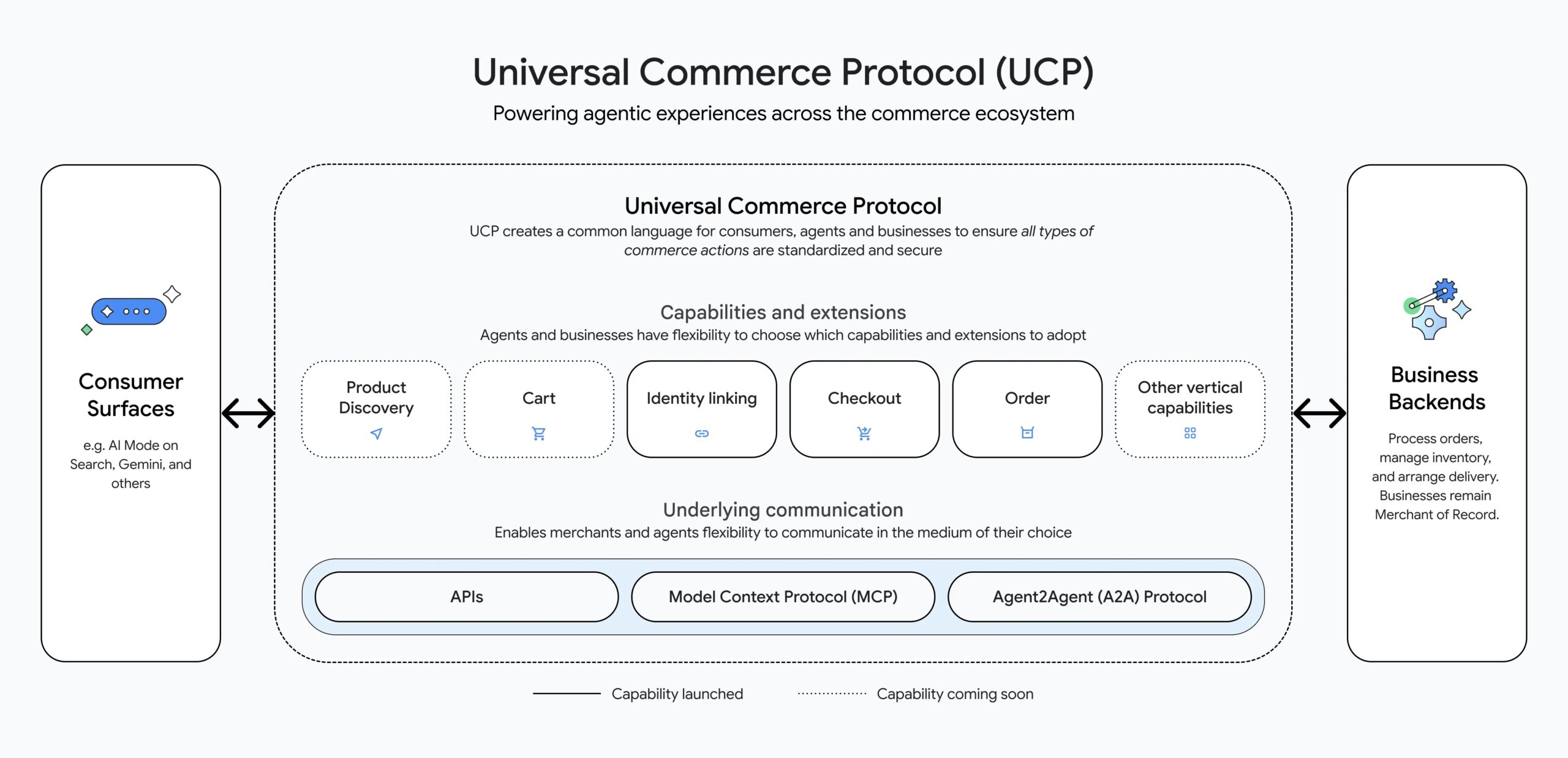
At its core, UCP is an open-source standard that establishes a common language among three key players in online shopping: AI platforms (such as Google’s Gemini or ChatGPT), businesses, and payment providers. Before UCP, each AI assistant needed custom integration with every retailer—a nightmare scenario as AI shopping becomes mainstream.
The protocol defines “capabilities” (core features such as checkout, order tracking, and identity linking) and “extensions” (add-ons like discounts or fulfillment options) that businesses can mix and match according to their needs. When an AI agent connects to a retailer, it automatically negotiates which features both sides support through a discovery process at .well-known/ucp, then seamlessly completes transactions using those agreed-upon capabilities.
What makes UCP particularly clever is its payment architecture. It separates what customers use to pay (payment instruments, such as credit cards or Google Pay) from how those payments are processed (payment handlers), allowing the system to work with virtually any payment provider without storing sensitive financial data on the platform side.
Why This Protocol Matters Now
The technology establishes a common language for agents and systems to operate together across consumer surfaces, businesses, and payment providers, eliminating the need for unique connections for every individual agent. Think of it as the USB-C of commerce—one standard that works everywhere, instead of retailers building custom integrations for every AI platform that pops up.
Google didn’t build this alone. The protocol was co-developed with industry leaders, including Shopify, Etsy, Wayfair, Target, and Walmart, and endorsed by more than 20 others across the ecosystem, like Adyen, American Express, Best Buy, Flipkart, Macy’s Inc., Mastercard, Stripe, The Home Depot, Visa, and Zalando.
“Shopify has a history of building checkouts for millions of unique retail businesses,” Vanessa Lee, vice president at Shopify, said in a statement. “We have taken everything we’ve seen over the decades to make UCP a robust commerce standard that can scale.”
What Actually Changes for Shoppers
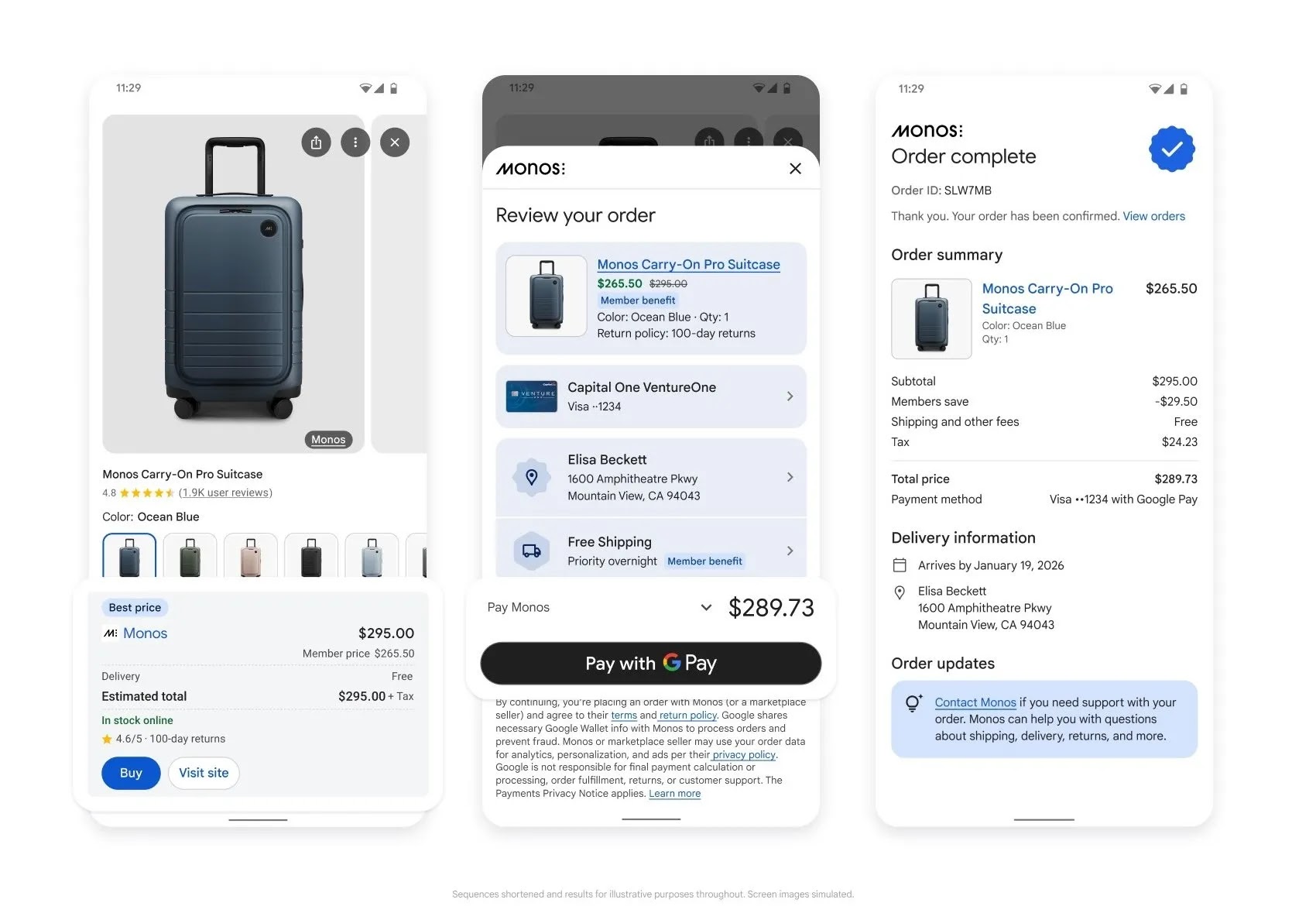
Starting soon, you’ll be able to buy products directly within Google Search’s AI Mode and the Gemini app without ever leaving the conversation. Imagine asking Gemini about lightweight suitcases, getting personalized recommendations, and completing the purchase right there using Google Pay—all within a few taps.
The feature reduces checkout friction by enabling direct purchases within the interaction flow, which could mean fewer abandoned shopping carts. The protocol initially supports Google Pay, with PayPal integration coming soon, though it’s designed to work with any payment provider.
Crucially, retailers remain the merchant of record. They keep control of customer data, relationships, and the ability to customize the checkout experience. For businesses, this isn’t about Google inserting itself between them and customers—it’s about meeting shoppers where the conversations are already happening.
The Technical Side (Without the Jargon)
UCP works through a discovery system where businesses publish what capabilities they support—things like checkout, order tracking, loyalty programs, and returns—in a standardized format. AI platforms can then dynamically discover what each retailer offers and connect seamlessly.
The protocol is compatible with existing industry standards, including Agent Payments Protocol (which Google launched last year), Agent2Agent, and Model Context Protocol. Developers can integrate with the system via REST APIs, and it utilizes tokenized payments with cryptographic proof of user consent for enhanced security.
For retailers already using Google Merchant Center for Shopping ads, the barrier to entry is relatively low. They’ll need to implement an agentic checkout service and enrich their product data with new attributes designed for AI consumption, but the foundational infrastructure already exists.
Interested retailers can join the waitlist through Google’s developer portal. The protocol specification is available as open source on GitHub for developers who want to build agentic commerce experiences.
The Bigger Picture
This announcement positions Google as a key player in what industry insiders are calling “agentic commerce”—where AI agents handle tasks on your behalf rather than just providing information. But it also represents a broader standards battle in the emerging world of AI-powered shopping.
OpenAI introduced a similar concept with Instant Checkout last September through its Agentic Commerce Protocol. Now, major retailers face a choice: build for multiple competing standards or wait to see which one wins market adoption.
Richard Crone, CEO of Crone Consulting, pointed out a potential concern: when checkout happens in an AI interface, merchants lose “the last touch point” where they can influence upselling or suggest complementary items—something that accounts for a significant portion of retail profits.
Still, the industry seems willing to make that trade-off for increased discoverability and conversion. Walmart announced that it will work with UCP to enable Gemini to automatically include products from Walmart and Sam’s Club, apply membership benefits, and combine orders across both brands.
What’s Next
Google plans to expand its checkout feature globally in the coming months, adding capabilities such as product discovery, loyalty rewards integration, and custom shopping experiences. The company is also introducing dozens of new data attributes in Merchant Center, specifically designed for conversational commerce, along with Direct Offers in Google Ads that enable retailers to present exclusive discounts to shoppers in AI Mode.
For consumers, the promise is simple: faster, smoother shopping that feels more like having a conversation with a knowledgeable sales assistant than filling out forms. For retailers, it’s access to the growing number of people who start their shopping journey by asking an AI assistant.
Whether UCP becomes the dominant standard or just one option among many remains to be seen. But with Google’s resources and the backing of major retailers, it’s clearly betting that shopping through AI conversations isn’t just a novelty—it’s the future. And that future starts soon.


Community Discussion
Join the conversation. Ask questions, share solutions, and help others.
Be the first to start the discussion!