


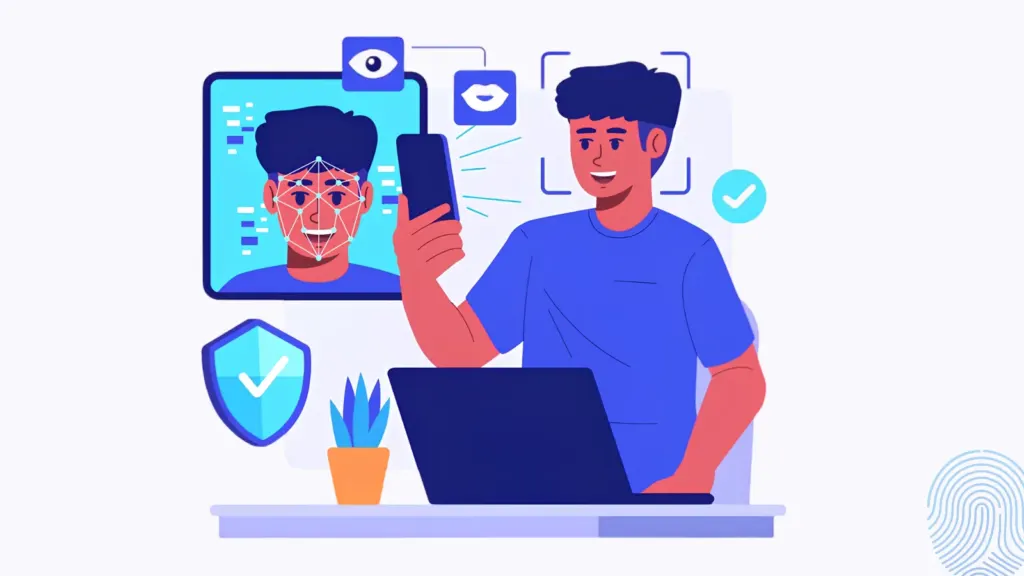
A stolen password can open an account, but a convincing fake face can help an attacker take control of one. As financial services, identity platforms, and consumer applications adopt facial verification, attackers are finding ways to fool the cameras meant to keep them out. For security teams, the challenge is no longer simply matching a face to an identity. It’s confirming that the person presenting it is physically present. On-device liveness checks address that problem, but their effectiveness depends on where and how they’re deployed.
Why account takeover is becoming a biometric security problem
Account takeover (ATO) typically begins with compromised credentials, phishing, or weaknesses in account recovery. Attackers gain unauthorised access to an existing account and may attempt to change its password, contact details, or authentication methods.
Multi-factor authentication (MFA) makes these attacks harder, but not every implementation provides the same protection. A stolen session token, compromised recovery channel, or successful social engineering attempt can undermine controls that otherwise appear secure.
Facial verification introduces another attack surface.
Consider an account recovery process that asks users to submit a selfie matching their previously registered photograph. If the system checks only facial similarity, an attacker possessing a convincing image of the account holder might attempt to pass verification without the legitimate user being present.
The problem isn’t necessarily poor facial recognition accuracy. The system may correctly determine that the submitted face resembles the enrolled identity, yet fail to establish whether the image was taken of a real person standing in front of the camera.
This distinction matters because biometric matching and proof of physical presence answer different security questions.
The NIST Digital Identity Guidelines for authentication explicitly recognise that biometric characteristics aren’t secrets. Facial images can be obtained without someone’s consent, and presentation attack detection helps address the resulting impersonation risks.
Security teams should therefore avoid treating a successful face match as sufficient evidence of legitimate account ownership.
How spoofing defeats ordinary facial verification
Facial spoofing attacks attempt to make a biometric system accept something other than a genuine, live presentation from the authorised person.
The attack doesn’t always require advanced software. Printed photographs, images displayed on another screen, and recorded videos can threaten systems that rely on basic image comparison.
More sophisticated attempts may involve three-dimensional masks or digitally manipulated facial media.
These techniques exploit different weaknesses.
A printed photograph presents a static representation of a face. A replayed video introduces movement that may satisfy simplistic checks for blinking or head rotation. Synthetic media can reproduce facial characteristics and expressions without requiring the actual person to participate.
There’s also a separate concern: injection attacks.
Instead of presenting a fake face to the physical camera, an attacker may attempt to introduce manipulated media into the capture pipeline. A system might receive convincing video frames while incorrectly assuming they originated from its trusted camera.
That makes camera access alone an unreliable security guarantee.
A useful distinction for defenders is between presentation attack detection, which examines attempts to deceive biometric capture, and injection attack detection, which addresses manipulation of the capture or processing pathway.
Both deserve attention during security testing.
A facial verification process that successfully handles printed images may still be vulnerable to synthetic video delivered via an untrusted input path.
What on-device liveness detection changes
Liveness detection assesses whether a biometric sample is from a living person physically present at the time of capture. Processing these checks on the user’s device changes how the verification workflow handles biometric information.
Traditional server-based architectures may transmit captured images to remote infrastructure for analysis. On-device architectures can perform the liveness assessment locally and return a verification result instead.
This is particularly relevant to privacy-sensitive applications.
With on-device liveness detection, developers can examine whether a facial capture appears genuine without necessarily transmitting the original image to a remote verification service. The security benefit still depends on the quality of the detection model and the integrity of the capture process.
Local processing also creates an opportunity to reduce the amount of sensitive biometric information travelling across networks.
That doesn’t automatically make an implementation secure.
An attacker controlling a compromised endpoint may attempt to interfere with the camera feed, modify application behavior, or forge the verification result. Developers must consider how the application establishes trust in the local processing environment and communicates its decision to the backend.
A liveness result should be bound to the current verification transaction, not accepted as a reusable approval.
Otherwise, a legitimate result from an earlier session could become another target for replay or manipulation.
Passive checks versus user-driven challenges
Some liveness systems require users to blink, turn their heads, or follow an onscreen instruction. These active checks introduce behavioral challenges intended to distinguish live capture from static or prerecorded material.
Passive systems attempt to assess liveness without requiring specific movements.
Neither approach should be judged solely by how convenient it feels.
Active challenges can create additional friction and may still be vulnerable to sufficiently convincing manipulated media. Passive methods reduce user interaction but require careful evaluation against the spoofing techniques relevant to the application.
For most consumer-facing identity workflows, passive assessment is a sensible starting point, provided independent testing demonstrates adequate resistance to realistic attacks.
Adding more user gestures isn’t automatically better security.
Where should liveness checks appear in the account lifecycle?
Liveness verification is most useful at moments when an application must establish or re-establish that a real person is presenting a claimed identity.
Running it indiscriminately at every login can create unnecessary friction. Reserve stronger identity checks for operations where impersonation would have serious consequences.
Account recovery is an obvious candidate.
Suppose an attacker has obtained a user’s email credentials and attempts to recover access to a financial account. The recovery workflow requests facial verification against an identity previously established during enrollment.
Without liveness detection, matching the submitted face may provide limited assurance that the authorised customer is actually participating.
A liveness assessment adds an additional check before the application accepts biometric evidence.
The same principle applies to enrollment. If an attacker can register a manipulated image as a new biometric identity, subsequent authentication controls may simply reinforce a fraudulently established identity.
Changes to security settings also deserve scrutiny.
Adding a new authentication method or replacing a recovery credential can give an attacker persistent access. Applications should evaluate whether these actions require renewed identity verification, rather than relying exclusively on an existing session.
The precise decision depends on the account’s risk profile. Not every profile update warrants biometric verification.
How to evaluate liveness detection before deployment
The first question shouldn’t be whether a vendor claims to detect deepfakes. It should be which attacks its technology has actually been tested against.
Security teams need evidence covering the capture methods and operating conditions their users encounter.
For systems following relevant NIST identity-proofing requirements, the NIST SP 800-63A-4 guidance requires presentation attack detection for remote biometric collection and comparison, with testing conformant to ISO/IEC 30107-3:2023.
That provides a more useful basis for evaluation than a marketing claim about spoofing prevention.
A practical assessment should cover:
- Attack resistance: Test printed photographs, screen replays, masks, and manipulated media appropriate to the deployment, including injection attacks where relevant.
- Capture integrity: Determine how the application protects camera input and prevents unauthorised alteration of verification results.
- False rejection: Check how often legitimate users encounter problems under poor lighting, with lower-quality cameras, or in ordinary usage conditions.
- Privacy: Establish what biometric information is stored, transmitted, retained, or deleted.
- Recovery: Provide a secure alternative when users cannot complete biometric verification.
Independent evaluations are preferable to vendor demonstrations because controlled demos rarely reproduce the range of devices and adversarial conditions found in production.
Security teams should also ask how model updates affect detection performance. A test result from one software version doesn’t automatically establish the effectiveness of a later release.
Why liveness checks cannot replace stronger authentication
Liveness detection protects a specific part of identity verification. It doesn’t establish that a device is trustworthy, prevent phishing, or prove that an account session hasn’t been stolen.
This limitation is easy to overlook when biometric technology is presented as an all-purpose fraud defence.
A live person can still be an attacker. Someone might pass liveness verification using their own face while attempting to register a fraudulent identity.
Likewise, a legitimate user may complete biometric verification during a malicious workflow without realising what action they’re authorising.
The defence must connect the biometric result to a trustworthy identity and a specific transaction.
For account authentication, phishing-resistant methods such as properly implemented passkeys can provide protection that liveness verification alone cannot.
Device binding, transaction-specific authorisation, session protection, and suspicious activity monitoring remain relevant even when biometric checks are present.
For sensitive workflows, the better approach is layered: use strong authentication to control access to the account, and apply liveness verification only when there’s a genuine need to verify physical presence.
Make the verification decision at the point of risk
Start by reviewing your account recovery and biometric enrollment workflows. Identify every point where a photograph, video, or facial match could authorise access or replace an existing credential.
Where physical presence matters, test liveness detection against realistic presentation and injection attacks before trusting it in production.
The practical rule is straightforward: a matching face identifies a resemblance; a properly secured liveness check helps establish presence. Account security needs to know the difference.


Community Discussion
Join the conversation. Ask questions, share solutions, and help others.
Be the first to start the discussion!